25 Essential Japanese Restaurant Phrases for Confident Dining
Updated: August 31, 2026 | Reading Time: 10 minutes
Eating in Japan is one of the better parts of the trip, right up until you're standing at the entrance of a restaurant with no picture menu and a staff member waiting for you to say something. Many places in central Tokyo have English menus. Many don't. The really good neighborhood spots, the ones with the handwritten signs outside and four tables inside, usually don't. These 25 phrases cover the full meal: getting seated, ordering, handling dietary restrictions, flagging a server, paying, and the two phrases said before and after every meal that most foreign visitors skip entirely.
| Japanese | Romaji | Meaning |
|---|---|---|
| 予約をお願いします | Yoyaku o onegaishimasu | I'd like to make a reservation, please |
| 二名です | Ni-mei desu | Party of two |
| 禁煙席をお願いします | Kin'en seki o onegaishimasu | Non-smoking seat, please |
| 窓側の席はありますか? | Madogawa no seki wa arimasu ka? | Do you have a window seat? |
| メニューをお願いします | Menyuu o onegaishimasu | Menu, please |
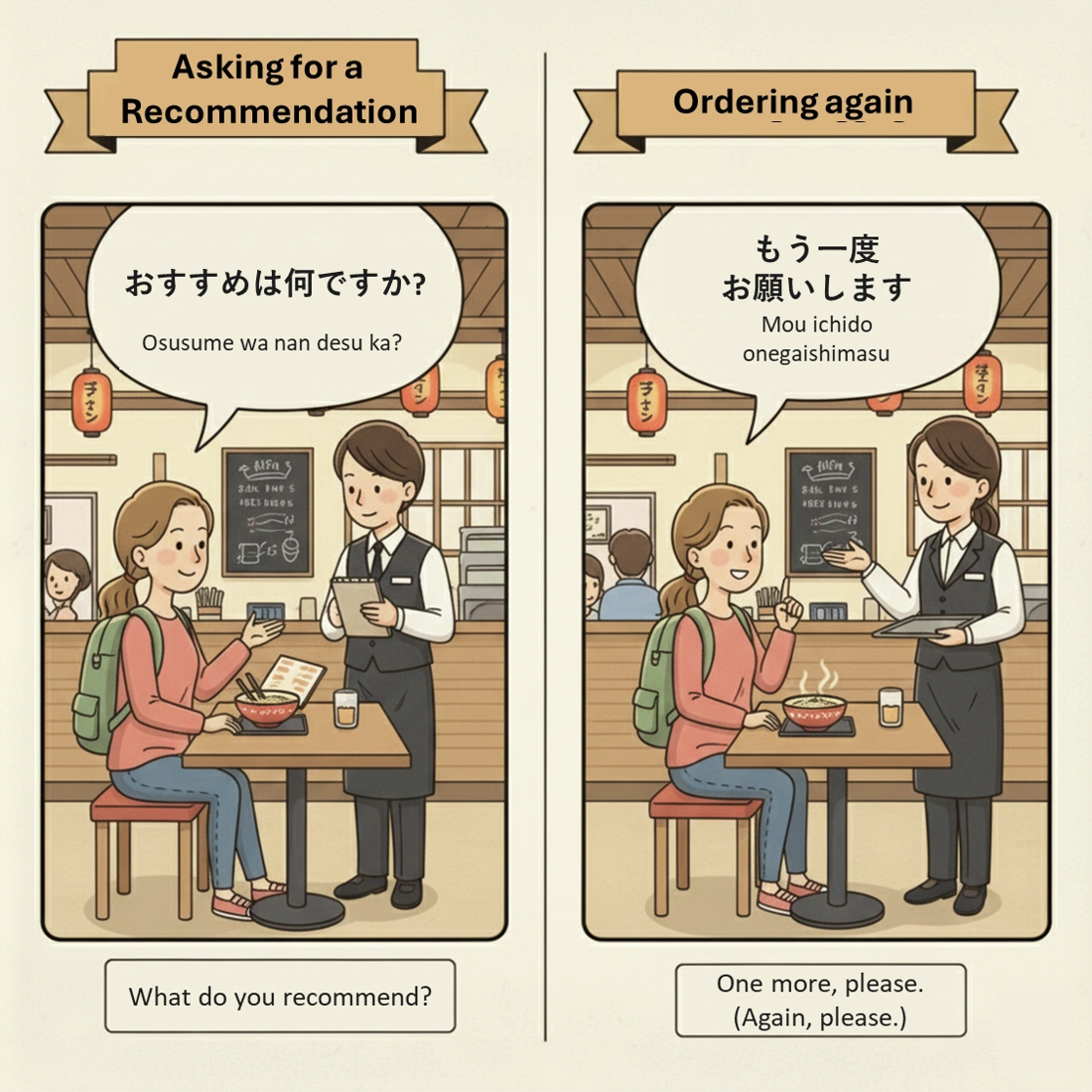
| おすすめは何ですか? | Osusume wa nan desu ka? | What do you recommend? |
| これをお願いします | Kore o onegaishimasu | This one, please |
| 同じものをください | Onaji mono o kudasai | The same thing, please |
| お水をください | O-mizu o kudasai | Water, please |
| ビールを二つください | Biiru o futatsu kudasai | Two beers, please |
| アレルギーがあります | Arerugii ga arimasu | I have an allergy |
| ___は食べられません | ___ wa taberaremasen | I cannot eat ___ |
| ベジタリアンです | Bejitarian desu | I'm vegetarian |
| 辛くないものはありますか? | Karakunai mono wa arimasu ka? | Do you have anything not spicy? |
| 少なめでお願いします | Sukuname de onegaishimasu | A small portion, please |
| いただきます | Itadakimasu | Thank you for this meal (said before eating) |
| おいしいです | Oishii desu | It's delicious |
| すみません | Sumimasen | Excuse me |
| お箸をください | O-hashi o kudasai | Chopsticks, please |
| もう一度お願いします | Mou ichido onegaishimasu | One more, please / Again, please |
| お会計をお願いします | O-kaikei o onegaishimasu | Check, please |
| クレジットカードは使えますか? | Kurejitto kaado wa tsukaemasu ka? | Can I use a credit card? |
| 別々でお願いします | Betsu-betsu de onegaishimasu | Separate checks, please |
| ごちそうさまでした | Gochisousama deshita | Thank you for the meal (said after eating) |
| ありがとうございました | Arigatou gozaimashita | Thank you very much (past tense) |
On This Page
1. Why Restaurant Phrases Matter 2. Entering & Getting Seated 3. Ordering Food & Drinks 4. Dietary Restrictions & Special Requests 5. During Your Meal 6. Paying & Leaving 7. Restaurant Etiquette Tips 8. Explore the "Essential Phrases" Series 9. Frequently Asked Questions1. Why Restaurant Phrases Matter
The practical reason to learn restaurant phrases is simple: menus aren't always in English, staff don't always speak it, and you need to be able to communicate two things: what you want, and what you can't eat. Japan is not an easy country for serious food allergies or strict dietary restrictions, and the phrases in that section are the ones worth studying most carefully.
Itadakimasu before eating and gochisousama deshita after are said at every meal by Japanese diners without a second thought. As a foreign visitor you're not obligated to use them. But if you do, and the cook is standing right there at a small restaurant, it tends to get noticed.
2. Entering & Getting Seated
Most restaurants seat you. You don't just pick a table and sit down. The first question after you walk in will almost always be about party size. Have a number ready.
-
予約をお願いしますYoyaku o onegaishimasuI'd like to make a reservation, please
Useful when calling ahead for popular spots or high-end restaurants. Many also take reservations through Tabelog or Google, but if you're calling directly, this is what you need.
-
二名ですNi-mei desuParty of two
Replace ni with: ichi (1), san (3), yon (4), go (5), roku (6). The suffix -mei is the counter for people in this context. Holding up fingers alongside the word works fine too.
-
二名 vs. 二人
You may already know 二人 (futari), which also means two people. In everyday Japanese, saying 二人です (futari desu) is completely natural and correct.
At restaurants, hotels, and other customer-service settings, staff often use 名 (mei) as a people counter: 一名 (ichi-mei) (one person), 二名 (ni-mei) (two people), 三名 (san-mei) (three people), and so on.
Japanese often has more formal words and counters that are common in business and service settings. For example, staff may say 本日 (honjitsu) instead of 今日 (kyō) for today, or 名 (mei) instead of 人 (nin) when counting customers.
Despite how it sounds, 名 (mei) is not an honorific like さん (san). It is a more formal counter commonly used in customer-service language. Using 二名です (ni-mei desu) when telling a host your party size sounds natural and matches the wording you'll often hear from restaurant staff, though 二人です (futari desu) is also perfectly natural.
-
禁煙席をお願いしますKin'en seki o onegaishimasuNon-smoking seat, please
Indoor smoking restrictions have tightened significantly since the 2020 revision of Tokyo's indoor smoking rules, but some izakayas still have designated smoking sections. Worth specifying upfront if it matters to you.
-
窓側の席はありますか?Madogawa no seki wa arimasu ka?Do you have a window seat?
Useful at restaurants with views. At sushi bars, asking for kaunta seki (counter seat) puts you in front of the chef, generally the better seat if you're going for omakase.
Irasshaimase
Walking into almost any restaurant in Japan, you'll be greeted with irasshaimase! (いらっしゃいませ, meaning "welcome"). You don't need to respond. A nod is fine. It's a standard greeting called out by staff, not a question directed at you specifically.
3. Ordering Food & Drinks
These six phrases cover almost every ordering situation. Pointing at the menu plus kore o onegaishimasu will get you through 90% of meals in Japan without any other vocabulary.
-
メニューをお願いしますMenyuu o onegaishimasuMenu, please
Some restaurants bring menus automatically, but this is helpful when they don't.
-
おすすめは何ですか?Osusume wa nan desu ka?What do you recommend?
One of the most useful things you can ask, especially at small specialty restaurants where the chef has a clear opinion about what you should be ordering. The answer will require some follow-up (pointing or nodding), but it often leads somewhere better than whatever you would have picked off the menu yourself.
-
これをお願いしますKore o onegaishimasuThis one, please
The universal ordering phrase. Point at the menu item and say this.
-
同じものをくださいOnaji mono o kudasaiThe same thing, please
For when the person next to you orders something that arrives and looks significantly better than what you have. No shame in it.
-
お水をくださいO-mizu o kudasaiWater, please
Water is free at most restaurants and comes automatically at some. At traditional Japanese restaurants you may be brought ocha (green tea) instead. It's also free, and just as fine.
-
ビールを二つくださいBiiru o futatsu kudasaiTwo beers, pleaseNumbers for ordering: hitotsu (1), futatsu (2), mittsu (3), yottsu (4), itsutsu (5)
Replace "biiru" with any drink: sake, wain (wine), uisukii (whiskey), kohii (coffee).
Reading Japanese Menus
Menus at mid-range and upscale Japanese restaurants often have no pictures and minimal English. Recognizing common kanji for ingredients and cooking methods (grilled, fried, raw, seasonal) makes the difference between ordering with some idea of what's coming and guessing entirely.
YoMoo provides daily Japanese articles with audio and instant lookups. Reading about food in Japanese before your trip builds the exact vocabulary you'll encounter on actual menus and in seasonal ingredient names.
4. Dietary Restrictions & Special Requests
This is the section to study most carefully if it applies to you. Vegetarian and vegan eating is genuinely hard in Japan, not because of unwillingness, but because dashi (fish stock) is a base ingredient in many dishes that appear meat-free, as JNTO's vegetarian and vegan guide explains. An allergy card in Japanese is worth having if your restrictions are serious.
-
アレルギーがありますArerugii ga arimasuI have an allergy
Follow with the ingredient: "Ebi ni arerugii ga arimasu" (I'm allergic to shrimp). Common allergens: tamago (egg), gyuunyuu (milk), komugi (wheat), soba, piinattsu (peanuts).
-
___は食べられません___ wa taberaremasenI cannot eat ___
More general than saying you have an allergy. Fill in with: niku (meat), sakana (fish), buta (pork), gyu (beef).
-
ベジタリアンですBejitarian desuI'm vegetarian
Many Japanese dishes that look vegetarian contain dashi, a fish-based stock used as a flavor base for soups, sauces, and simmered vegetables. If dashi is an issue, add dashi mo dame desu (no dashi either). Without that clarification, vegetarian requests often result in dishes that technically have no meat but are still not fish-free.
-
辛くないものはありますか?Karakunai mono wa arimasu ka?Do you have anything not spicy?
Japanese food isn't typically very spicy, but some dishes (like curry or certain ramen) can be.
-
少なめでお願いしますSukuname de onegaishimasuA small portion, please
For "large portion": "Oomori de onegaishimasu" (大盛りでお願いします).
For Serious Allergies: Carry a Card
If your allergy is severe, have a written card in Japanese that lists your specific allergens clearly. Several websites offer free printable allergy cards for Japan travel. Hand it to the server when you order. It removes ambiguity and gives staff something concrete to take to the kitchen. Spoken phrases alone aren't always sufficient when the stakes are high.
5. During Your Meal
Two of these are said by Japanese diners at every meal without thinking. Two are for mid-meal interactions. Learn all of them. They're short.
-
いただきますItadakimasuThank you for this meal (said before eating)
Said before eating. It's a brief acknowledgment of the food and everyone involved in producing it. Japanese diners say it quietly before every meal, at home and in restaurants. You don't need to announce it; saying it to yourself before picking up your chopsticks is exactly right.
-
おいしいですOishii desuIt's delicious
Worth saying directly to the chef or server at small restaurants, especially counter-style places where staff can hear you. At casual spots, oishii! without the desu is perfectly natural.
-
すみませんSumimasenExcuse me
The standard way to get a server's attention. Say it at a normal volume with eye contact. That's it. Snapping, waving aggressively, or calling out repeatedly will make staff and nearby diners uncomfortable. One clear sumimasen is always enough.
-
お箸をくださいO-hashi o kudasaiChopsticks, please
Replace "hashi" with: foku (fork), spuun (spoon), naifu (knife), oshibori (wet towel), napukin (napkin).
-
もう一度お願いしますMou ichido onegaishimasuOne more, please / Again, please
Useful at izakayas when ordering another round, or at restaurants where a particular dish was good enough to order again. Pair it with pointing at an empty plate or your glass.
6. Paying & Leaving
Japan doesn't have table-side bill service the way Western restaurants do. At most places, you pay at a register near the exit. There's a specific way to ask for the bill, and two phrases you say before leaving that most foreign visitors skip.
-
お会計をお願いしますO-kaikei o onegaishimasuCheck, please
Say this to a server, or make an X with your index fingers. Both work. At many restaurants, rather than bringing the bill to you, they'll direct you to pay at the front register on your way out.
-
クレジットカードは使えますか?Kurejitto kaado wa tsukaemasu ka?Can I use a credit card?
Card acceptance keeps growing, as noted in JNTO's cashless payments guide, but some smaller restaurants are still cash-only. Always good to check first.
-
別々でお願いしますBetsu-betsu de onegaishimasuSeparate checks, please
Splitting bills isn't standard in Japan and some restaurants won't accommodate it. The easier approach is having one person pay and sorting it out afterward, or each paying separately at the register rather than asking for itemized splits.
-
ごちそうさまでしたGochisousama deshitaThank you for the meal (said after eating)
Said as you leave. The standard way Japanese diners close out a meal: a thanks for the food and the work behind it. At a small restaurant where the chef can hear you on the way out, this lands better than just walking past. Most foreign visitors skip it. Most Japanese diners don't.
-
ありがとうございましたArigatou gozaimashitaThank you very much (past tense)
Said as you leave. The past tense form is appropriate here because the meal and service have concluded. Use this alongside gochisousama deshita rather than instead of it.
No Tipping in Japan
Tipping is not practiced in Japan, a point confirmed in Japan's tipping customs as described by the national tourism organization. Leaving money on the table or handing it to a server can cause genuine confusion. Staff have been known to chase customers down the street to return it. Good service is the baseline expectation, not something that earns a bonus. Say oishikatta desu (it was delicious) or gochisousama deshita on the way out. That's the appropriate expression of appreciation.
7. Restaurant Etiquette Tips
A few of these are practical. A few are the ones that get Western tourists in trouble without realizing it. The chopstick rules, in particular, have origins in funeral rituals, as laid out in the Japan National Tourism Organization's official etiquette guidelines. They're worth knowing, not because anyone will call you out, but because they add useful context.
Do:
- Wait to be seated (don't choose your own table)
- Say "Itadakimasu" before eating
- Slurp your noodles. It's a compliment!
- Use the serving chopsticks (tori-bashi) for shared dishes
- Place your chopsticks on the holder between bites
- Pay at the register, not at the table
Don't:
- Stick chopsticks upright in rice (funeral ritual)
- Pass food chopstick-to-chopstick (funeral ritual)
- Pour soy sauce directly on rice
- Talk loudly. Japanese restaurants are typically quiet
- Leave a tip
- Walk around while eating
8. Explore the "Essential Phrases" Series
Here are the other guides in this series for the specific situations you'll actually run into:
On Transportation
Trains, buses, IC cards, and how to ask for help when the transfer doesn't make sense.
Read Now →
At the Restaurant
Ordering, dietary restrictions, getting the bill, and what to say when you leave.
Current Article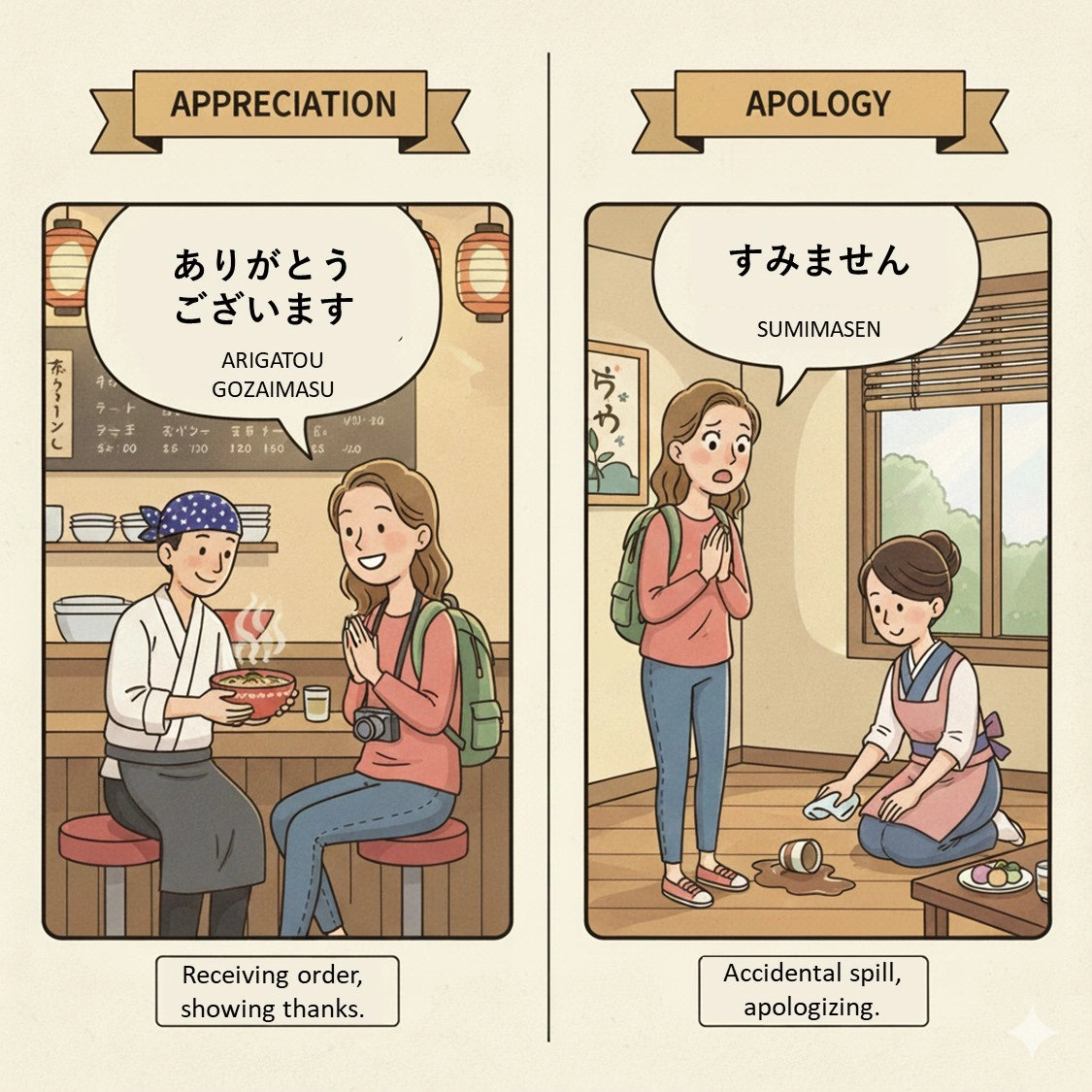
Survival Phrases
The 20 phrases that cover most daily situations: greetings, ordering, directions, emergencies.
Read Now →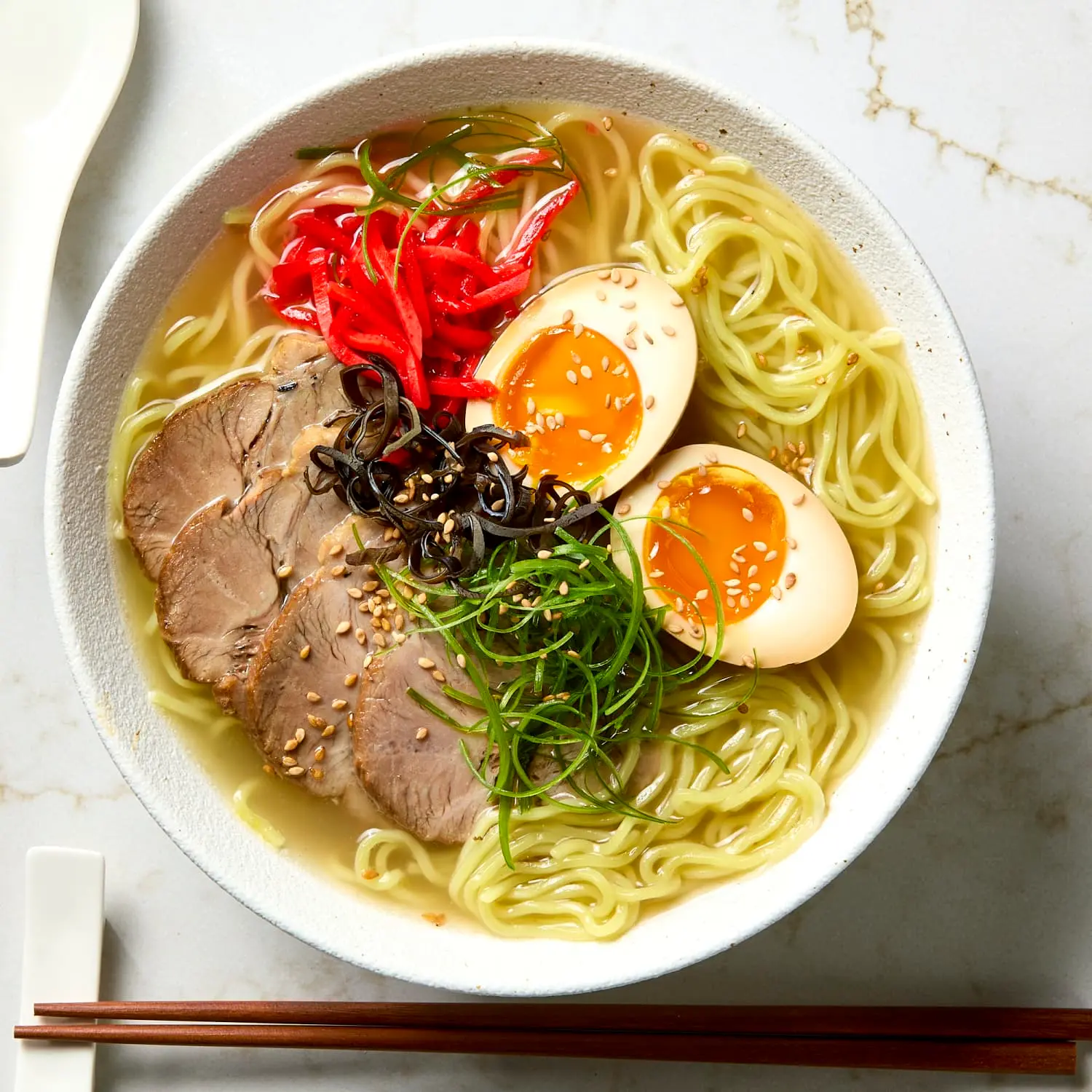
Ramen Vocabulary
Broth types, toppings, customization options, and what to say at the counter.
Read Now →9. Frequently Asked Questions
Do I need to make reservations at Japanese restaurants?
How do I know if a restaurant accepts credit cards?
What's the difference between "Itadakimasu" and
"Gochisousama"?
Is it rude to not finish all my food in Japan?
How do I handle food allergies or dietary restrictions in
Japan?
What should I do if I don't understand the menu?
Final Thoughts
Learn itadakimasu, gochisousama deshita, and sumimasen and you'll handle most restaurant situations in Japan without much friction. The allergy and dietary restriction phrases deserve extra attention if they apply to you. You might still end up with a dish you didn't expect from time to time, but by then you'll have the vocabulary to ask what it actually is.