FluencyTool
How FluencyTool works
FluencyTool is a Japanese speaking practice app for learners who can read kana. You hear a Japanese sentence, say it back, and speech-to-text shows what it heard. This page goes through each part of the app: the shadowing loop, what the score means, the 25 levels, the Kanji Tower, flashcards, the English track and what is free.
The shadowing loop: listen, record, compare, score
Shadowing means repeating a sentence right after you hear it. FluencyTool's Echo Fluency mode runs the whole loop for you, so a session is a series of short attempts with no tapping in between.
- Listen. A JLPT-graded sentence appears with furigana above the kanji, and Google Cloud text-to-speech reads it in a female or male voice at the speed you choose.
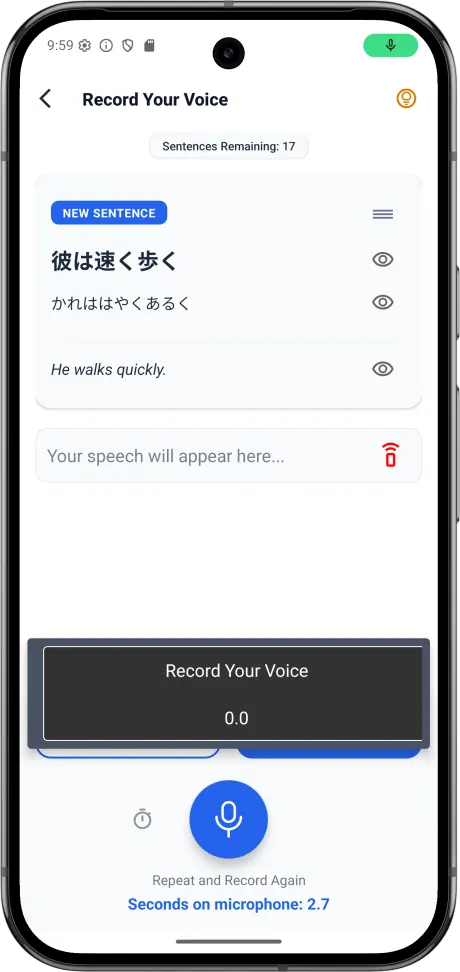
- Record. The microphone opens as soon as the audio ends, so you can practise with your hands busy. The red wave on the Recording screen moves with your voice, which shows the microphone is picking you up.
- Compare. Your recording plays straight after the model sentence. Hearing the two back to back makes differences in rhythm and sounds easier to notice.
- Score. Speech-to-text transcribes what you said and FluencyTool compares it with the target sentence. A missed sentence comes back later in the same session.
There are three recording modes: Echo Fluency (Auto) runs the full hands-free cycle, Timed plays the audio and then gives you a fixed recording window, and Hold to Record is push-to-talk.
What the score measures, and what it does not
The score is a comparison of words, not a pronunciation grade. Speech-to-text turns your voice into text, and FluencyTool checks that text against the sentence you were meant to say.
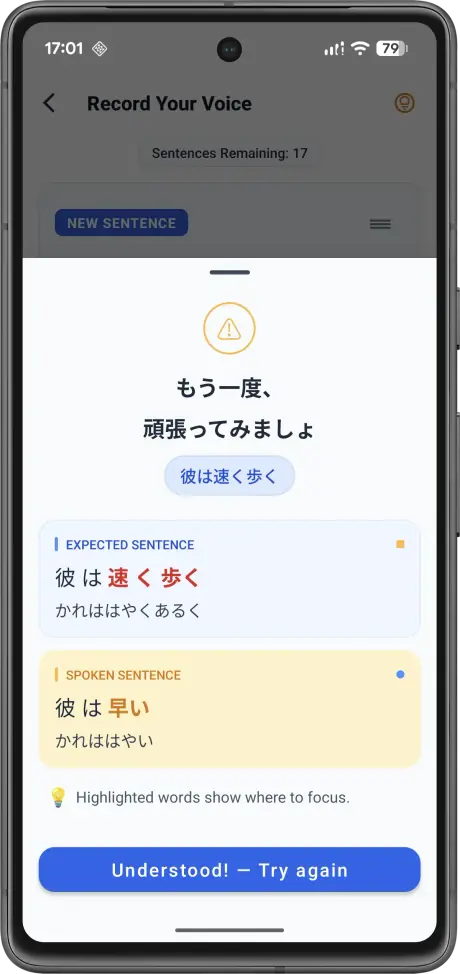
- It measures whether the recogniser understood your sentence: which words it heard, and which parts of the sentence are missing or different.
- It does not measure pitch accent, vowel length, intonation or how natural you sound. A recogniser can accept an attempt a Japanese listener would find odd, and it can miss a good attempt in a noisy room.
- Use both signals: the score tells you the sentence came through; the playback straight after the model sentence is where you judge rhythm and sounds yourself.
For pitch accent on its own, the free Pitch Accent Lab shows the high and low pattern of a word. On the research side, a Purdue study of 30 intermediate Japanese learners found changes in pausing patterns after a semester of shadowing, but not faster delivery; the shadowing guide has the details.
25 sub-levels from JLPT N5 to N1
You pick one of the five JLPT levels, and each level is split into five FluencyTool sub-levels, which makes 25 groups of sentences. Vocabulary, grammar and sentences are filtered to the level you choose.
| Level | Sub-levels | What the sentences cover |
|---|---|---|
| N5 | 5 | Beginner: foundational vocabulary and survival phrases |
| N4 | 5 | Elementary: basic sentences and common patterns |
| N3 | 5 | Intermediate: everyday conversation and conjunctions |
| N2 | 5 | Upper intermediate: nuanced expression and reading fluency |
| N1 | 5 | Advanced: complex grammar and literary forms |
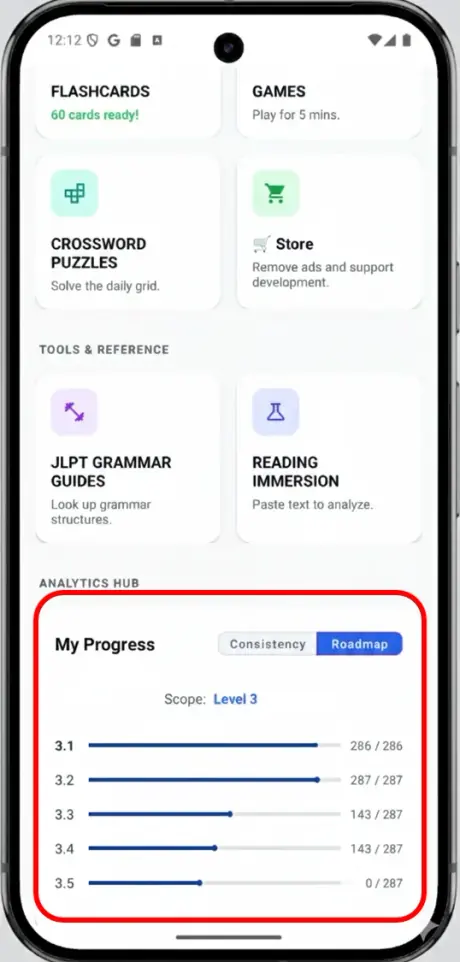
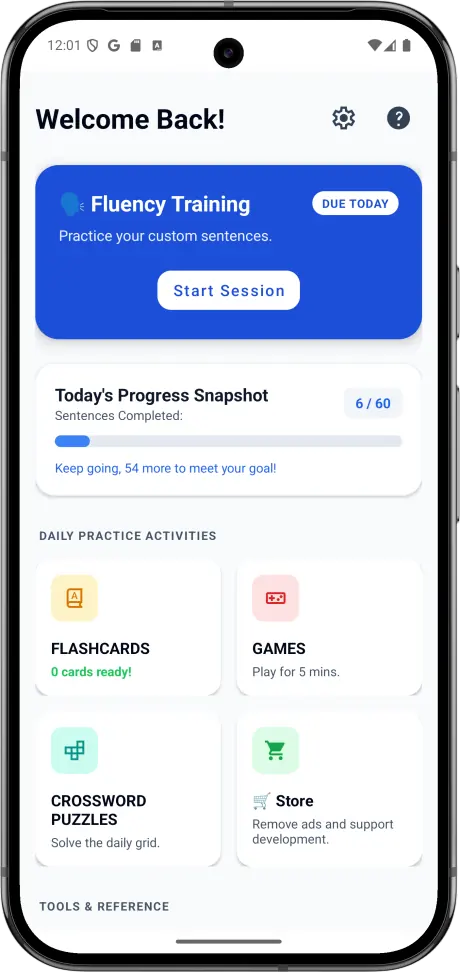
Romaji appears only in the lowest N5 survival phrases; past that point the course expects hiragana and katakana, with furigana available above kanji. The Dashboard shows your daily goal, the sentences and cards due, your streak, and a roadmap with how many new sentences remain in each sub-level.
Kanji Tower: write the 1,026 school kanji
The Kanji Tower is a writing course for the 1,026 kanji Japanese children learn in elementary school. It has 103 floors with 6 to 10 kanji each, taught inside 3,924 example sentences, and every stroke you draw is checked.
- Learn: each kanji arrives with its meaning, readings and a sentence. You trace it into the gap, then write it with a faded outline and a start marker.
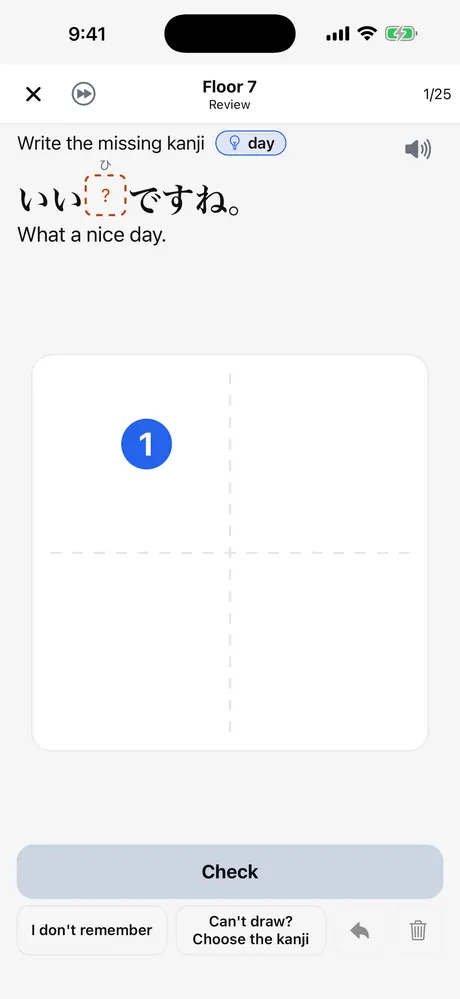
- Produce: the outline goes away. You write the missing kanji in a sentence, or the kanji for a word you hear, and each stroke is marked.
- Review: kanji you wrote first time come back later, and ones you needed help with come back sooner. A Reviews due button shows how many are ready and runs them in one go, and you can review a single floor.
- Placement: if you already know some kanji, a placement check starts you just below your first miss.
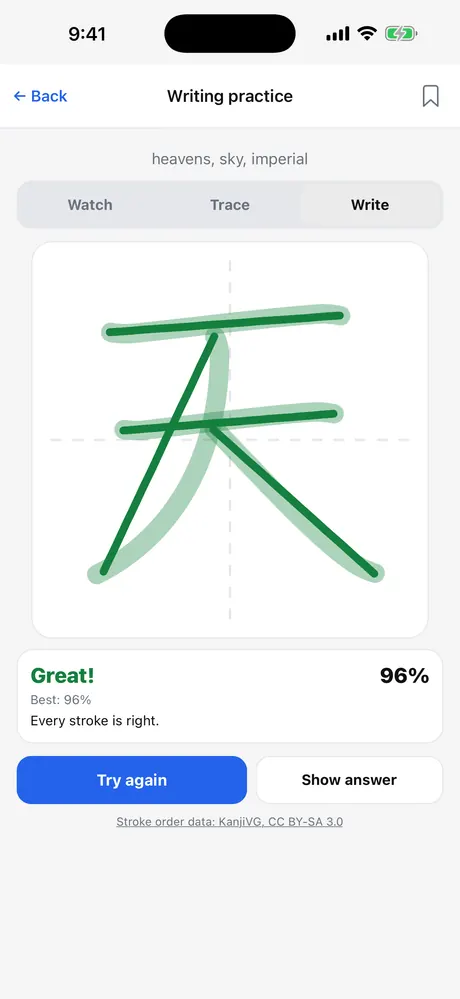
Outside the Tower, the dictionary has Watch, Trace and Write practice for all 2,136 jōyō kanji, and the Stats screen shows your Tower progress for each school grade. See the Kanji Tower: all 1,026 school kanji by grade for the full list and the order the floors follow.
SM-2 flashcards
Vocabulary flashcards follow Woźniak's original SM-2 description. You rate each card Again, Hard, Good or Easy, and its interval and ease factor change with the rating; after five or more correct reviews a card counts as mature and moves to intervals of several weeks.
- JLPT preset decks for N5 to N1 are imported on first launch.
- Custom decks take a word, reading, definition and example.
- Long-press a kanji for its on and kun readings, name readings and meanings.
- Spoken sentences run on their own schedule: mastering a sentence five times multiplies its review interval by 4.
The English track
FluencyTool also teaches English speaking with the same loop. The English speaking track, graded A1 to B2 uses CEFR levels instead of JLPT levels, and the app has 2,498 English practice sentences; Indonesian translations of them arrived in version 3.0.104.
Free, with one optional ad removal
The core app is free to download and use: Echo Fluency, the Kanji Tower, flashcards, the grammar guide, vocabulary games and crosswords. There is no trial, no card on file and no subscription. A single one-time in-app purchase removes the ads. An account is optional and only needed for cloud sync.
Try a sentence today
Free on Android and iPhone, with one optional purchase to remove ads. No account needed.
FluencyTool questions
Does FluencyTool grade my pronunciation?
Not directly. Speech-to-text writes down what it heard and FluencyTool compares that with the target sentence, so the score tells you whether your sentence was recognised. It does not rate pitch accent, vowel length or how natural you sound. Your own recording plays back after the model sentence so you can judge those yourself.
Do I need to read hiragana and katakana first?
Yes, beyond the very first lessons. The lowest JLPT N5 survival phrases show romaji; after that the sentences are in Japanese script, with furigana above the kanji. If you cannot read kana yet, start with Kana Challenge.
What do I need for Echo Fluency?
A phone, tablet or computer with a microphone and an internet connection. The connection supplies the sentence audio and the speech-to-text check. Flashcard reviews and the vocabulary games work offline.
Is the Kanji Tower part of the free app?
Yes. The Kanji Tower, the dictionary, Echo Fluency, flashcards, the grammar guide and the vocabulary games are all in the free app. The only purchase is a one-time upgrade that removes the ads.
Can I use FluencyTool without an account?
Yes. FluencyTool works without an account. An account is optional and only needed for cloud sync, which carries your progress and flashcards between devices.