Kanji by grade · Kanji Tower
Kanji by grade: the 1,026 kanji Japanese children learn, and an order that works for adults
Japanese children learn 1,026 kanji in grades 1 to 6 of elementary school, out of the 2,136 jōyō kanji for everyday use. The Kanji Tower in FluencyTool teaches the same 1,026 kanji in 103 floors built around words, for adults who are learning the words and the kanji together.
| Kanji | School grade | Kanji Tower |
|---|---|---|
| 私 | Grade 6after at least 835 other kanji | Floor 5Water, earth and meeting |
- 1,026kanji in elementary school
- 80 to 202kanji per school year
- 2,136jōyō kanji for everyday use
- 103Kanji Tower floors
- 3,924example sentences
How Japanese schools teach kanji
Kanji by grade: 1,026 kanji in six years of elementary school
Two official documents set the standard. The jōyō kanji list (常用漢字表) has 2,136 kanji for everyday use; the Japanese Cabinet issued the current list on 30 November 2010. The Course of Study (学習指導要領) from the Ministry of Education (MEXT) decides which of those kanji are taught in each year, in its grade allocation table (学年別漢字配当表).
Elementary school covers 1,026 of the 2,136. These are the kyōiku kanji, the education kanji. By the end of junior high school, students are expected to be able to read most of the rest.
| School year | New kanji | Running total |
|---|---|---|
| Grade 1 | 80 | 80 |
| Grade 2 | 160 | 240 |
| Grade 3 | 200 | 440 |
| Grade 4 | 202 | 642 |
| Grade 5 | 193 | 835 |
| Grade 6 | 191 | 1,026 |
Every kanji, grade by grade
Grade 1: 80 kanji
Numbers, the sun and moon, and things a six-year-old can point at, such as 山 (mountain), 川 (river), 犬 (dog) and 虫 (insect).
一 七 三 上 下 中 九 二 五 人 休 先 入 八 六 円 出 力 十 千 口 右 名 四 土 夕 大 天 女 子 字 学 小 山 川 左 年 手 文 日 早 月 木 本 村 林 校 森 正 気 水 火 犬 玉 王 生 田 男 町 白 百 目 石 空 立 竹 糸 耳 花 草 虫 見 貝 赤 足 車 金 雨 青 音
Grade 2: 160 kanji
Directions, countries and roads: 東 西 南 北, 国 and 道.
万 丸 交 京 今 会 体 何 作 元 兄 光 公 内 冬 刀 分 切 前 北 午 半 南 原 友 古 台 合 同 回 図 国 園 地 場 声 売 夏 外 多 夜 太 妹 姉 室 家 寺 少 岩 工 市 帰 広 店 弓 引 弟 弱 強 当 形 後 心 思 戸 才 教 数 新 方 明 星 春 昼 時 晴 曜 書 朝 来 東 楽 歌 止 歩 母 毎 毛 池 汽 活 海 点 父 牛 理 用 画 番 直 矢 知 社 秋 科 答 算 米 紙 細 組 絵 線 羽 考 聞 肉 自 船 色 茶 行 西 親 角 言 計 記 話 語 読 谷 買 走 近 通 週 道 遠 里 野 長 門 間 雪 雲 電 頭 顔 風 食 首 馬 高 魚 鳥 鳴 麦 黄 黒
Grade 3: 200 kanji
Places and daily life, such as 駅 (station), 病 and 院 (hospital) and 薬 (medicine).
丁 世 両 主 乗 予 事 仕 他 代 住 使 係 倍 全 具 写 列 助 勉 動 勝 化 区 医 去 反 取 受 号 向 君 味 命 和 品 員 商 問 坂 央 始 委 守 安 定 実 客 宮 宿 寒 対 局 屋 岸 島 州 帳 平 幸 度 庫 庭 式 役 待 急 息 悪 悲 想 意 感 所 打 投 拾 持 指 放 整 旅 族 昔 昭 暑 暗 曲 有 服 期 板 柱 根 植 業 様 横 橋 次 歯 死 氷 決 油 波 注 泳 洋 流 消 深 温 港 湖 湯 漢 炭 物 球 由 申 界 畑 病 発 登 皮 皿 相 県 真 着 短 研 礼 神 祭 福 秒 究 章 童 笛 第 筆 等 箱 級 終 緑 練 羊 美 習 者 育 苦 荷 落 葉 薬 血 表 詩 調 談 豆 負 起 路 身 転 軽 農 返 追 送 速 進 遊 運 部 都 配 酒 重 鉄 銀 開 院 陽 階 集 面 題 飲 館 駅 鼻
Grade 4: 202 kanji
Includes the 20 kanji used in prefecture names, such as 埼, 奈, 岡 and 熊.
不 争 井 付 令 以 仲 伝 位 低 佐 例 便 信 倉 候 借 健 側 働 億 兆 児 共 兵 典 冷 初 別 利 刷 副 功 加 努 労 勇 包 卒 協 単 博 印 参 司 各 周 唱 器 固 城 埼 塩 変 夫 失 奈 好 媛 季 孫 完 官 害 富 察 岐 岡 崎 巣 差 希 席 帯 底 府 康 建 径 徒 徳 必 念 愛 成 戦 折 挙 改 敗 散 料 旗 昨 景 最 望 未 末 札 材 束 松 果 栃 栄 案 梅 梨 械 極 標 機 欠 残 氏 民 求 沖 治 法 泣 浅 浴 清 満 滋 漁 潟 灯 無 然 焼 照 熊 熱 牧 特 産 的 省 祝 票 種 積 競 笑 管 節 約 結 給 続 縄 置 群 老 臣 良 芸 芽 英 茨 菜 街 衣 要 覚 観 訓 試 説 課 議 貨 賀 軍 輪 辞 辺 連 達 選 郡 量 録 鏡 関 阜 阪 陸 隊 静 順 願 類 飛 飯 養 香 験 鹿
Grade 5: 193 kanji
Formal and abstract words, such as 政 (government) and 経 (economy).
久 仏 仮 件 任 似 余 価 保 修 個 停 備 像 再 刊 判 制 則 効 務 勢 厚 句 可 史 告 喜 営 因 団 囲 圧 在 均 型 基 堂 報 境 墓 増 士 夢 妻 婦 容 寄 導 居 属 布 師 常 幹 序 弁 張 往 得 復 志 応 快 性 情 態 慣 技 招 授 採 接 提 損 支 政 故 救 断 旧 易 暴 条 枝 査 格 桜 検 構 武 歴 殺 毒 比 永 河 液 混 減 測 準 演 潔 災 燃 版 犯 状 独 率 現 留 略 益 眼 破 確 示 祖 禁 移 程 税 築 粉 精 紀 素 経 統 絶 綿 総 編 績 織 罪 義 耕 職 肥 能 脈 興 舎 航 術 衛 製 複 規 解 設 許 証 評 講 謝 識 護 豊 象 財 貧 責 貯 貸 費 貿 資 賛 賞 質 輸 述 迷 逆 造 過 適 酸 鉱 銅 防 限 険 際 雑 非 領 額 飼
Grade 6: 191 kanji
More formal words, such as 憲 (constitution) and 権 (rights), and everyday ones like 私 (I).
並 乱 乳 亡 仁 供 俳 俵 値 傷 優 党 冊 処 券 刻 割 創 劇 勤 危 卵 厳 収 后 否 吸 呼 善 困 垂 域 奏 奮 姿 存 孝 宅 宇 宗 宙 宝 宣 密 寸 専 射 将 尊 就 尺 届 展 層 己 巻 幕 干 幼 庁 座 延 律 従 忘 忠 恩 憲 我 批 承 担 拝 拡 捨 探 推 揮 操 敬 敵 映 晩 暖 暮 朗 机 枚 染 株 棒 模 権 樹 欲 段 沿 泉 洗 派 済 源 潮 激 灰 熟 片 班 異 疑 痛 皇 盛 盟 看 砂 磁 私 秘 穀 穴 窓 筋 策 簡 糖 系 紅 納 純 絹 縦 縮 署 翌 聖 肺 胃 背 胸 脳 腸 腹 臓 臨 至 舌 若 著 蒸 蔵 蚕 衆 裁 装 裏 補 視 覧 討 訪 訳 詞 誌 認 誕 誠 誤 論 諸 警 貴 賃 退 遺 郵 郷 針 銭 鋼 閉 閣 降 陛 除 障 難 革 頂 預 骨
Why the school order is hard for adults
A Japanese child already knows the word. An adult learner usually does not.
A six-year-old already says 病院 (びょういん, hospital) every week. School only has to attach the written form to a word the child can say and understand. An adult learner is usually meeting the word and the kanji at the same time, and the school order was not built for that.
The kanji: new
Learns the kanji.
The kanji: new
Learns the word and the kanji together.
Follow the school order as an adult and you learn kanji for words you have not met yet, and wait for the kanji you need now. The sentence 私は日本語の試験のために毎日勉強します (I study for the Japanese exam every day) uses nine different kanji from five school years, and its first word, 私, is taught in grade 6.
| Word | School order | Kanji Tower |
|---|---|---|
| 私わたし “I” | Grade 6, after at least 835 other kanji | Floor 5, kanji number 50 |
| 子供こども “child” | Grade 6, after at least 835 other kanji | Floor 11, kanji number 102 |
| 現在げんざい “now” | Grade 5, after at least 642 other kanji | Floor 15, kanji number 143 |
| 済むすむ “to finish” | Grade 6, after at least 835 other kanji | Floor 34, kanji number 337 |
| 難しいむずかしい “difficult” | Grade 6, after at least 835 other kanji | Floor 50, kanji number 494 |
| 森もり “forest” | Grade 1, taught in the first school year | Floor 85, kanji number 843 |
| 姉あね “older sister” | Grade 2, after at least 80 other kanji | Floor 84, kanji number 831 |
The Kanji Tower in FluencyTool
The same 1,026 kanji, in 103 floors built around words
The Kanji Tower assumes you may be learning the word and the kanji for the first time. Each floor of 6 to 10 kanji is a small set of words that belong together, and every kanji comes with common words and short sentences, so the only new things are the kanji and its word.
Floor 1
Numbers, people and days
一二十三人言八日月九
Words: 一つ、二十、三人、一月
Floor 13
Eating, working and moving
別面決食士仕古加動由
Words: 食べる、仕事、動く、決める
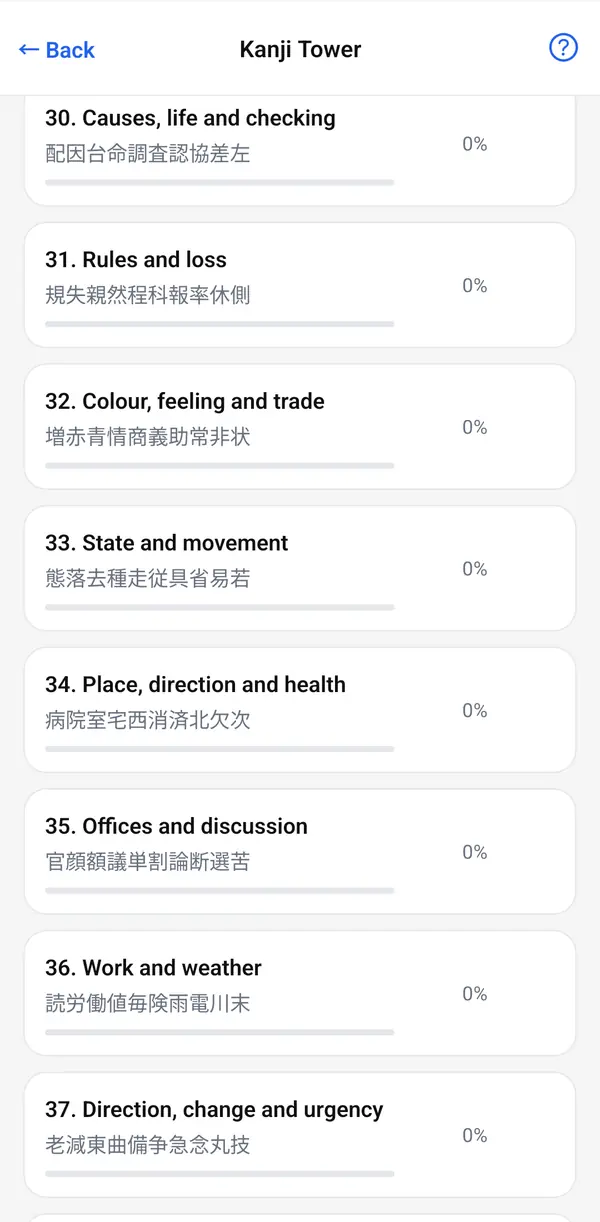
Floor 34
Place, direction and health
病院室宅西消済北欠次
Words: 病院、教室、西、北、済む
Floor 52
Tests and groups
歌景試験積仲隊障談勤
Words: 試験、相談、仲間、勤める
Themes carry on across floors
- Compass西floor 34北floor 34東floor 37南floor 43
- Colours赤floor 32青floor 32
- Opposites増floor 32減floor 37
- Last岐 阪 鹿 縄 熊 崎 奈 岡 阜 茨 栃 梨 埼 滋 媛 潟prefecture-name kanji, floors 99 to 103
Sentences you can already read
3,924 example sentences across 103 floors
81% contain no kanji you have not learned yet.
99% contain one unfamiliar kanji at most, shown with its reading above it.
The 7,581 words in those sentences that contain kanji:
- 73% are words the Tower has taught by that floor
- 17% are written only with kanji you have met
- 10% show furigana, and you can tap them for the meaning
1,148 of 1,238 compound words (93%) pair the new kanji with one from an earlier floor, so older kanji keep coming back.
Computed from the Kanji Tower content on 26 October 2026, for a learner who works through the floors in order.
How a floor works
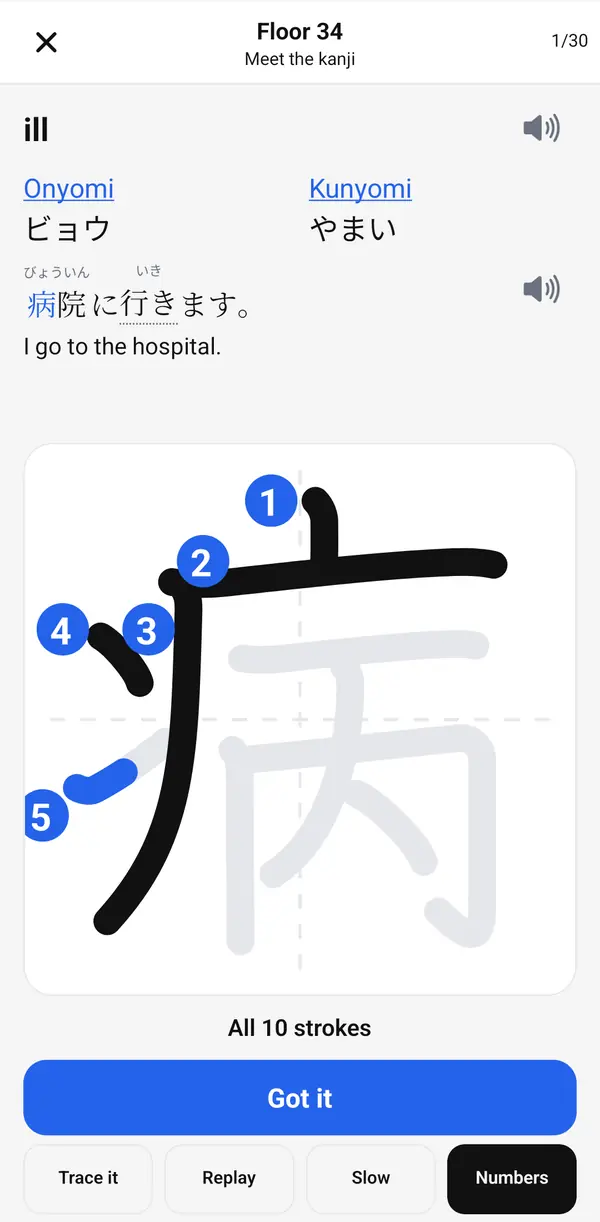
Meet each kanji with its meaning, readings and a sentence, watch the stroke order, trace it, then write it with help.
Write the kanji from memory into a sentence, or write the kanji for a word you hear. Every stroke is checked.
Kanji you wrote first time come back later; kanji you needed help with come back sooner.
Already know some kanji? Find your floor tests a sample of the floors and starts you just below your first miss.
See where you stand next to a Japanese schoolchild
The Statistics screen shows your Kanji Tower progress against each school grade: strong, learning and not started, out of 80, 160, 200, 202, 193 and 191.
Get FluencyTool free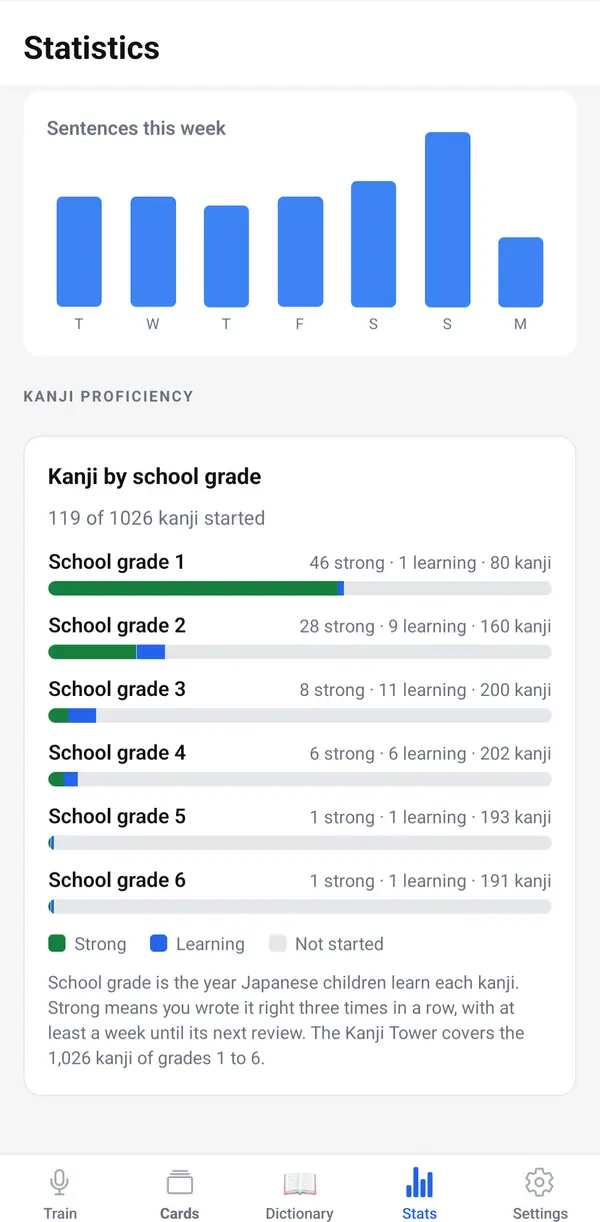
Frequently asked questions about kanji by grade and the Kanji Tower
How many kanji do Japanese children learn in elementary school?
Japanese children learn 1,026 kanji in the six years of elementary school. These kanji are called kyōiku kanji (education kanji) and are a subset of the 2,136 jōyō kanji for everyday use.
How many kanji are taught in each grade?
The current table has 80 kanji in grade 1, 160 in grade 2, 200 in grade 3, 202 in grade 4, 193 in grade 5 and 191 in grade 6, which adds up to 1,026.
Why do some sites say Japanese children learn 1,006 kanji?
Older sources describe the table before the 2017 revision, which had 1,006 kanji. The revision added the 20 kanji used in prefecture names to grade 4 and moved 32 kanji between grades 4, 5 and 6, and it has applied in elementary schools since April 2020.
Who decides which kanji are taught in each grade?
Japan's Ministry of Education (MEXT) sets the grade for each kanji in the Course of Study (学習指導要領) and its grade allocation table (学年別漢字配当表). The wider list of 2,136 jōyō kanji was set by a Cabinet notice on 30 November 2010.
What are jōyō kanji?
Jōyō kanji are the 2,136 kanji in the Cabinet's 2010 list of kanji for everyday use in laws, official documents, newspapers and broadcasting. Elementary school covers 1,026 of them, and students are expected to be able to read most of the rest by the end of junior high school.
Should adult learners study kanji in school-grade order?
School-grade order was designed for children who already speak Japanese and only need to learn how to write words they know. An adult learner usually meets the word and the kanji together, so an order built around words is easier to follow: in school order, 私 (I) comes in grade 6, after at least 835 other kanji.
What is the Kanji Tower?
The Kanji Tower is the kanji writing course in FluencyTool, a free Japanese learning app for Android and iPhone. It teaches the 1,026 elementary-school kanji in 103 floors of 6 to 10 kanji, with example sentences and stroke-by-stroke writing practice.
How is the Kanji Tower ordered?
The Kanji Tower groups kanji into floors around words that belong together, such as hospital, room and home on floor 34, and its example words use only kanji from that floor or earlier ones. It places 私 on floor 5, while school order teaches it in grade 6.
Do I need to know the Japanese words before starting the Kanji Tower?
No. The Kanji Tower assumes you may be learning the word and the kanji at the same time, so every kanji comes with common words and short sentences. In 81% of its 3,924 sentences, every kanji is one you have already learned.
Is the Kanji Tower free?
Yes. The Kanji Tower is part of FluencyTool, which is free on Android and iPhone; one optional in-app purchase removes the ads.
Can I start the Kanji Tower partway through?
Yes. Find your floor tests a sample of the floors and starts you just below the first one you miss, and you can also jump to any floor and return to your own floor at any time.
Keep learning
- FluencyToolThe app with the Kanji Tower, shadowing practice and a 45,064-word dictionary.
- Why one kanji has many readingsOnyomi and kunyomi, the next question after the grade lists.
- Kana ChallengeNot finished hiragana and katakana yet? Start there.
Kanji and kana videos on the MySenpai YouTube channel
Sources
- Jōyō kanji: 常用漢字表 (Cabinet Notice No. 2, 30 November 2010), Agency for Cultural Affairs
- Course of Study, published 31 March 2017 and in force from April 2020: 学習指導要領, Ministry of Education (MEXT)
- The 2017 revision (20 prefecture-name kanji added to grade 4, 32 kanji moved between grades 4 to 6): MEXT, elementary Course of Study commentary, Japanese
- Per-grade counts: Digital Daijisen (Shogakukan) via Kotobank, 学習漢字
- Kanji grade data: KANJIDIC2, Electronic Dictionary Research and Development Group, CC BY-SA 4.0. Stroke order: KanjiVG, CC BY-SA 3.0.
Start the Kanji Tower on floor 1
FluencyTool is free on Android and iPhone. One optional purchase removes the ads.