A kanji radical (部首, bushu) is the part of a kanji that dictionaries file it under, and it is often a hint at what the kanji means. 海, 池, 泳 and 洗 (sea, pond, swim, wash) all share 氵, the water radical. Radicals repeat across thousands of kanji: by our count, just 10 radicals are the radical of 1 in 3 of the 2,136 jōyō kanji (725, or 33.9%), and 20 cover 51% (1,089).

49-second video. More on the MySenpai YouTube channel.
In short
- Every kanji has one radical; most kanji are built from several smaller parts.
- The traditional list has 214 radicals, but a small set does most of the work: start with the 20 below.
- Radicals keep their strokes and stroke order in every kanji, so they are the natural first step in writing kanji.
What is a kanji radical?
Most kanji are built from smaller parts. 休 (rest) is 亻, a person, next to 木, a tree: a person resting against a tree. One of the parts of each kanji is its radical, the part a kanji dictionary sorts it under. For 休 that is 亻.
The radical system comes from China. The Kangxi Dictionary, compiled in 1716, sorted characters under 214 radicals, and Japanese kanji dictionaries still use that list. Paper dictionaries are arranged by radical and then by stroke count, which is how you looked up a kanji you could not read before phone dictionaries.
Radical or component? Components are all the parts of a kanji; the radical is the one part it is filed under. 語 (language) contains 言, 五 and 口, and its radical is 言, speech. Some learning systems use “radical” for any component; this article uses the dictionary meaning.
The 20 most common radicals in the jōyō kanji
Each row is one radical. Read across: the radical itself, what it means, its Japanese name (with romaji), three kanji that use it, and how many of the 2,136 jōyō kanji (the official list of kanji for everyday use) are filed under it. The longer the bar, the more kanji. The top 10 rows reach 33.9% of the list and all 20 reach 51%.
| # | Radical and meaning | Japanese name | Example kanji | Kanji with this radical |
|---|---|---|---|---|
| 1 | 氵water | さんずい sanzui | 海sea池pond泳swim | 112 |
| 2 | 亻person | にんべん ninben | 休rest体body作make | 90 |
| 3 | 扌hand | てへん tehen | 持hold指finger打hit | 87 |
| 4 | 木tree, wood | きへん kihen | 林woods森forest机desk | 85 |
| 5 | 口mouth | くちへん kuchihen | 味taste呼call吸inhale | 71 |
| 6 | 言speech, words | ごんべん gonben | 話talk語language読read | 68 |
| 7 | 糸thread | いとへん itohen | 紙paper線line結tie | 63 |
| 8 | 土earth, soil | つちへん tsuchihen | 地ground場place坂slope | 50 |
| 9 | 月moon; flesh | つきへん tsukihen にくづき nikuzuki | 服clothes腕arm脳brain | 50 |
| 10 | 辶movement, road | しんにょう shinnyō | 道road近near送send | 49 |
| The top 10 together are the radical of 725 jōyō kanji, 33.9% of the 2,136. | ||||
| 11 | 日sun, day | ひへん hihen | 時time明bright曜weekday | 48 |
| 12 | 艹grass, plants | くさかんむり kusakanmuri | 花flower草grass茶tea | 46 |
| 13 | 心heart, feeling | こころ kokoro | 思think意meaning感feel | 43 |
| 14 | 女woman | おんなへん onnahen | 好like姉older sister妹younger sister | 36 |
| 15 | 宀roof | うかんむり ukanmuri | 家house室room安safe | 36 |
| 16 | 貝shell, money | かいへん kaihen | 買buy貯save費spend | 35 |
| 17 | 金metal, gold | かねへん kanehen | 銀silver鉄iron鏡mirror | 33 |
| 18 | 忄heart, feeling | りっしんべん risshinben | 情feeling性nature慣get used to | 31 |
| 19 | 阝hill (left side) | こざとへん kozatohen | 院institution階floor陽sun | 30 |
| 20 | 刂knife | りっとう rittō | 前before別separate刻carve | 26 |
| All 20 together are the radical of 1,089 jōyō kanji, 51% of the 2,136. | ||||
How to read the names. Most radical names are a thing plus a position word. へん (偏) means “the part on the left”, so てへん is “hand, on the left” and きへん is “tree, on the left”. After a ん the へ is voiced to べ, so にんべん (person) and ごんべん (speech) are the same ending, just pronounced べん. かんむり means “on top” and にょう means “wrapping around”. The names are only labels: you do not need them to learn a radical, and you can learn the shape and meaning first.
Counting a radical together with its other shapes gives higher numbers: 水 and 氵 together are the radical of 118 jōyō kanji, and the top 20 merged radicals reach about 54%. Lists that merge forms, or count every part inside a kanji rather than only its radical, give different totals; the order of the top radicals stays much the same. In this data, 月 covers both “moon” and “flesh” (にくづき, as in 腕 and 脳), which look the same in modern kanji.
Radicals change shape and position
Many radicals take a narrower form when they share space with other parts. The meaning stays the same.
| Full form | Inside a kanji | Example |
|---|---|---|
| 水 | 氵さんずい | 海 (sea) |
| 人 | 亻にんべん | 休 (rest) |
| 手 | 扌てへん | 持 (hold) |
| 心 | 忄りっしんべん | 情 (feeling) |
| 火 | 灬れんが, れっか | 点 (point), 熱 (heat) |
| 犬 | 犭けものへん | 猫 (cat) |
| 刀 | 刂りっとう | 前 (before) |
| 阜 | 阝(left)こざとへん | 院 (institution) |
| 邑 | 阝(right)おおざと | 部 (part), 都 (capital) |
Radicals also have names for where they sit. Japanese radical names often end in one of these words:
| Position | Japanese | Example |
|---|---|---|
| Left | へん (偏), also read べん after ん, as in にんべん | 亻 in 休 |
| Right | つくり (旁) | 阝 in 部 |
| Top | かんむり (冠) | 艹 in 花 |
| Bottom | あし (脚) | 心 in 思 |
| Top and left | たれ (垂) | 广 in 店 |
| Wrapping the bottom left | にょう (繞) | 辶 in 道 |
| Enclosing | かまえ (構) | 囗 in 国 |
Why radicals make kanji easier
- They hint at meaning. Kanji with 言 are often about words (話 talk, 語 language, 読 read); kanji with 扌 are often things you do with your hands (持 hold, 打 hit). Often, not always: 校 (school) has the tree radical 木 and nothing to do with trees.
- A new kanji is mostly parts you know. 紙 (paper) is 糸 plus 氏. Remembering two familiar parts is easier than remembering ten loose strokes.
- They separate look-alikes. 持 (hold) and 待 (wait) differ only on the left: 扌 hand versus 彳, the “step” radical.
Test yourself: find the radical
Each of these kanji has one of the top-10 radicals. Guess it, then open the card.
泳 Which radical?
氵 water (swim)
作 Which radical?
亻 person (make)
押 Which radical?
扌 hand (push)
語 Which radical?
言 speech (language)
紙 Which radical?
糸 thread (paper)
Radicals are the first step in writing kanji
Radicals are short and they repeat. 氵 is 3 strokes and it is written the same way, in the same order, in every kanji that has it: in the jōyō kanji alone it is the radical of 112 and appears in more. Practising the common radicals first means most new kanji start with strokes your hand already knows. A good first five, the five most common radicals in the table:
| Radical | Meaning | Strokes | Write it in |
|---|---|---|---|
| 氵 | water | 3 | 海 池 泳 |
| 亻 | person | 2 | 休 体 作 |
| 扌 | hand | 3 | 持 指 打 |
| 木 | tree | 4 | 林 森 机 |
| 口 | mouth | 3 | 味 呼 吸 |
Stroke order rules carry over too: top before bottom, left before right. If you learned kana with stroke order, you already know the habit; see the hiragana stroke order guide if you are still on kana.
Practising radicals and kanji in FluencyTool
In the Japanese kanji writing practice app FluencyTool, every kanji page shows the kanji’s radical next to its readings and stroke count, with buttons to watch the strokes and practise writing. The dictionary’s Radicals list shows the radicals that are kanji in their own right, such as 人, 水 and 木, and a short “What is a radical?” sheet explains what you are looking at. All 2,136 jōyō kanji have Watch, Trace and Write practice with every stroke checked.
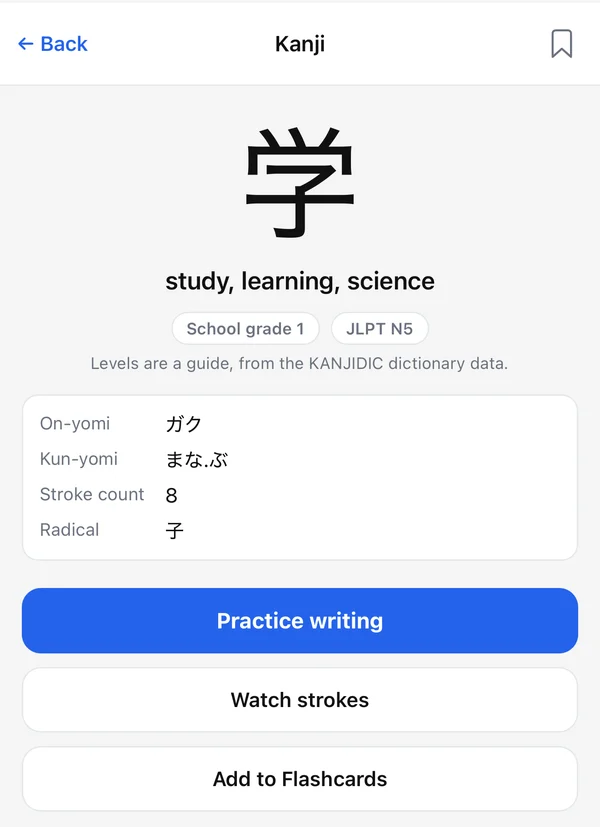
The kanji page for 学: its radical is 子, child.
For learning kanji through words in context, the Kanji Tower teaches the 1,026 kanji of Japanese elementary school in real sentences, a floor of about ten at a time.
How many radicals should you learn?
Not all 214 at once. Some radicals appear in only a few everyday kanji, and learning them in isolation is memorising for its own sake. A practical order:
- Learn the top 20 from the table: their shape, meaning and stroke count. They are the radical of 51% of the jōyō kanji.
- Learn the position names (へん, つくり, かんむり and the rest) so radical names make sense.
- Pick up the rest as you meet them: when a new kanji has an unfamiliar radical, look at two or three other kanji that share it.
Reading kanji is the other half of the job. Most kanji have two kinds of reading; our guide to onyomi and kunyomi explains how to tell which one a word uses.
Frequently asked questions
How many kanji radicals are there?
The traditional list has 214 radicals, taken from the Kangxi Dictionary of 1716, and Japanese kanji dictionaries still file kanji under them. Many radicals also have a second shape they take inside other kanji, such as 水 becoming 氵, so you will see more than 214 shapes in practice.
Do I need to learn all 214 radicals?
No. Some radicals appear in only a handful of everyday kanji. By our count, the 20 most common radicals are the radical of 51% of the 2,136 jōyō kanji, so learning those first covers about half. Learn the rest as you meet them in new kanji.
What is the most common kanji radical?
氵, the water radical (さんずい), is the radical of 112 of the 2,136 jōyō kanji, more than any other in our count. Counting its full form 水 as well gives 118. 亻 (person), 扌 (hand), 木 (tree) and 口 (mouth) come next.
Are radicals and components the same thing?
No. Components are all the parts a kanji is built from; the radical is the one part a dictionary files the kanji under. 語 contains 言, 五 and 口, and its radical is 言. Every radical is a component, but most components in a kanji are not its radical.
Is the radical always on the left side?
No. It can sit on the left (休), the right (部), the top (花), the bottom (思), along the top and left (店), wrap the bottom left (道) or enclose the kanji (国). Left is the most common position (975 of the 2,136 jōyō kanji in the KanjiVG data), which is why so many radical names end in へん, “left side”.
How do radicals help with writing kanji?
A radical is written the same way in every kanji that contains it, with the same strokes in the same order. Once you can write 氵 (3 strokes), you can write that part of 海, 池, 泳 and over a hundred other jōyō kanji. Short, repeated parts are easier to practise than whole kanji.
Last reviewed November 2, 2026. Counts: KanjiVG radical tags over the 2,136 jōyō kanji (jōyō kanji table of 2010), counted by My Senpai; variant forms counted separately. Dictionaries do not all agree on every kanji’s radical, so a few kanji may be filed differently in the dictionary you use.