Say きょうはてんきがいいね, get scored. Free Japanese speaking practice that listens.
FluencyTool is a free Japanese app for speaking and kanji. Echo Fluency scores your shadowing with speech-to-text from JLPT N5 to N1, and the Kanji Tower teaches you to write all 1,026 elementary-school kanji, with every stroke checked.
- JLPT N5 to N1 · 25 sub-levels
- Speech-to-text scoring
- Kanji Tower: 1,026 kanji
- No account, subscription or card
- iOS, Android and web
- 4.5 ★ on Google Play
Press start. The sentence plays, then the microphone opens for you to repeat it.
We heard:
Uses your microphone only while you speak. Nothing is saved by My Senpai; recognition runs through your browser's speech service (Chrome, Edge and Safari). Your recording stays in your browser for playback and is not uploaded. The app adds sentence review across 25 levels.
Kanji Tower: learn to write every elementary-school kanji, floor by floor
The Kanji Tower is a writing course for all 1,026 kanji that Japanese children learn in elementary school. Each floor teaches 6 to 10 kanji inside real sentences, and every stroke you draw is checked. See kanji by grade, and how the Kanji Tower orders all 1,026 school kanji.
- 103floors
- 1,026elementary-school kanji
- 3,924example sentences
- 2,136jōyō kanji with writing practice
Learn: meet it, trace it, write it with help
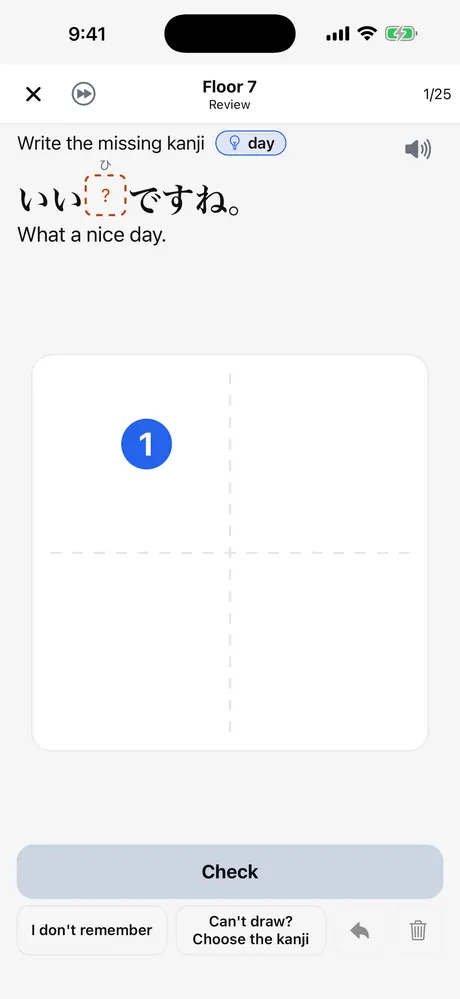
Each kanji arrives with its meaning, readings and a sentence. You trace it into the gap in the sentence, then write it with a faded outline and a start marker.
Produce: write it from memory
The second step drops the outline. You write the missing kanji in a sentence, or the kanji for a word you hear, and the app marks each stroke.
Review: it comes back before you forget it
Kanji you wrote first time come back later; ones you needed a hint for come back sooner. Already know some? Find your floor samples every tenth floor and starts you just below your first miss.
Every kanji through junior high, in the dictionary
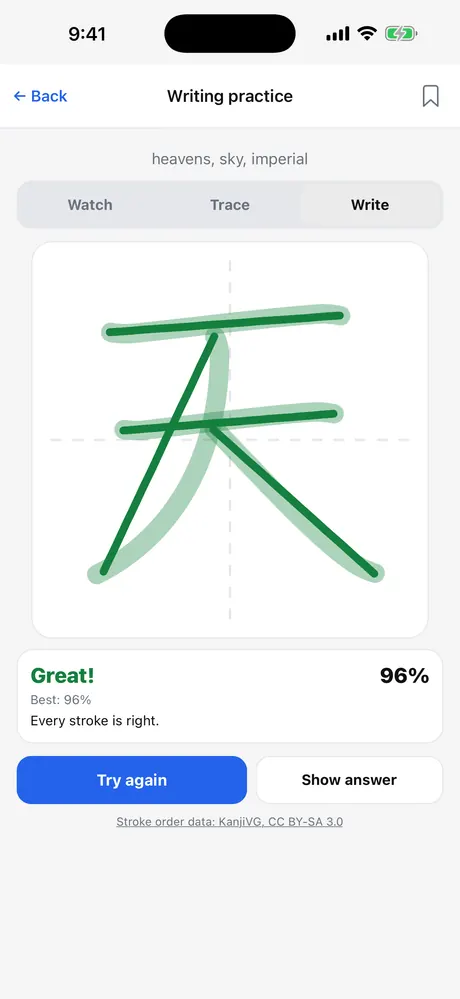
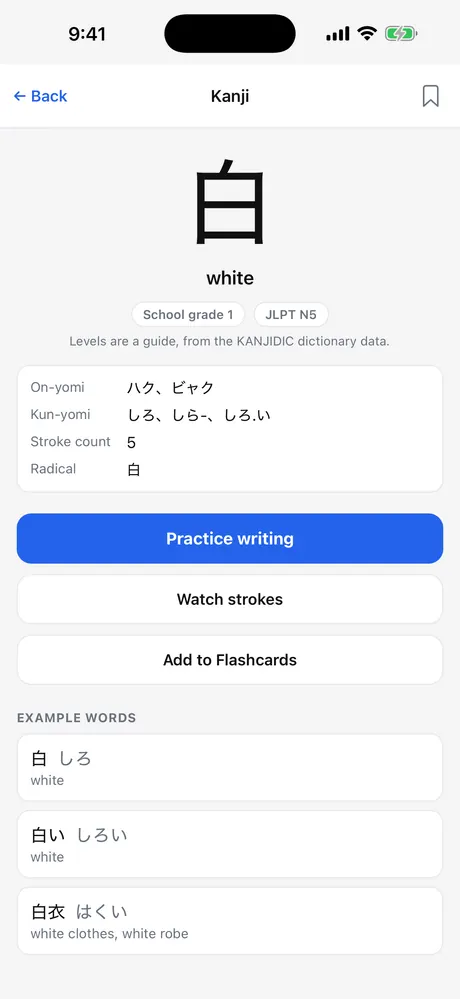
All 2,136 jōyō kanji, the set taught through junior high school, have Watch, Trace and Write practice with every stroke checked. Search 45,064 words, browse kanji by school grade, and open any kanji for its meanings, on and kun readings, school grade, JLPT level, stroke count, radical and example words. Words of 2 to 4 characters, like 日本語, can be written as a whole.
Stroke order data: KanjiVG, CC BY-SA 3.0. Grades and levels from the KANJIDIC dictionary data.
Japanese shadowing practice: how Echo Fluency works in 3 steps
Echo Fluency automates the listen → repeat → compare loop. Native audio plays, recording starts when playback ends, your voice plays back, and speech-to-text evaluates the attempt.
Hear the sentence in a native voice
A JLPT-graded sentence such as 今日は天気がいいですね appears with furigana above the kanji (きょう, てんき). Google Cloud TTS plays it at the speed you choose.
Repeat it hands-free, then hear yourself
The microphone opens automatically when playback ends, so you can practice while your hands are busy. Your recording plays straight after the native model, which makes differences in rhythm and sounds easier to hear.
Get scored and review at the right time
Speech-to-text transcribes what you said and compares it with the target sentence. Incorrect sentences re-queue in the same session, and mastering a sentence five times multiplies its speaking review interval by 4.
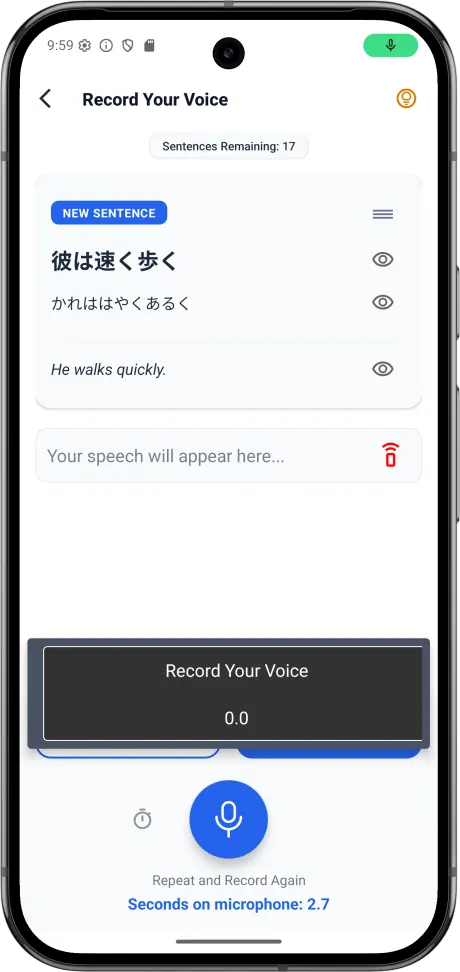
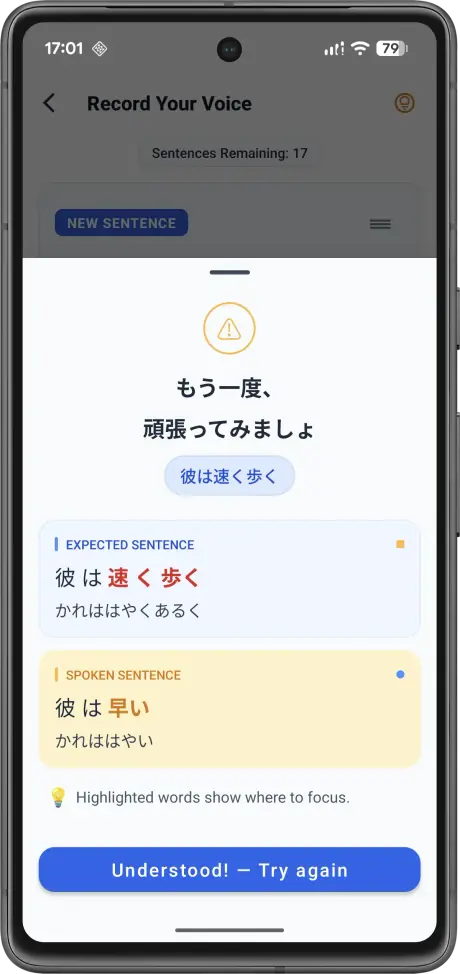
Three recording modes: Echo Fluency (Auto), the full hands-free cycle · Timed, audio then a fixed recording window · Hold to Record, push-to-talk.
A Purdue study of 30 intermediate Japanese learners found measurable changes in pausing patterns after a semester of shadowing; the study did not find faster delivery. Read the shadowing guide.
Everything in FluencyTool uses the same JLPT-graded content
Japanese speaking practice from JLPT N5 to N1
Choose one of the five official JLPT levels, then work through five FluencyTool sub-levels inside it. That creates 25 content buckets for speaking practice.
| N5 | Beginner · 5 sub-levels · foundational vocabulary & survival phrases |
|---|---|
| N4 | Elementary · 5 sub-levels · basic sentences & common patterns |
| N3 | Intermediate · 5 sub-levels · everyday conversation & conjunctions |
| N2 | Upper-intermediate · 5 sub-levels · nuanced expression & reading fluency |
| N1 | Advanced · 5 sub-levels · complex grammar & literary forms |
The lowest N5 survival-phrase content includes romaji. Beyond that entry point, the course expects hiragana and katakana; furigana can appear above kanji.
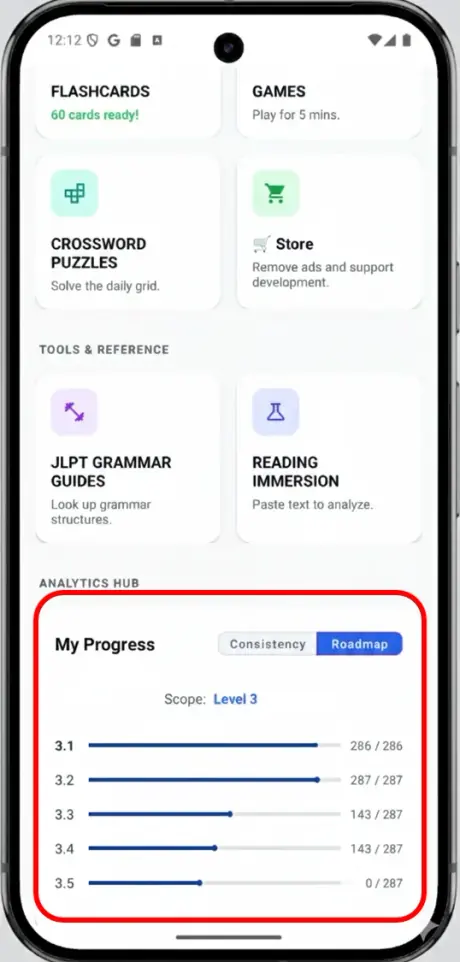
Japanese vocabulary flashcards on an SM-2 schedule
Flashcards use Woźniak's original SM-2 description. Rate a card Again, Hard, Good or Easy and its interval and ease factor adjust accordingly. After five or more correct reviews a card is treated as mature and moves to multi-week intervals.
- JLPT preset decks: N5 to N1 vocabulary imported on first launch.
- Custom decks: word, reading, definition and example.
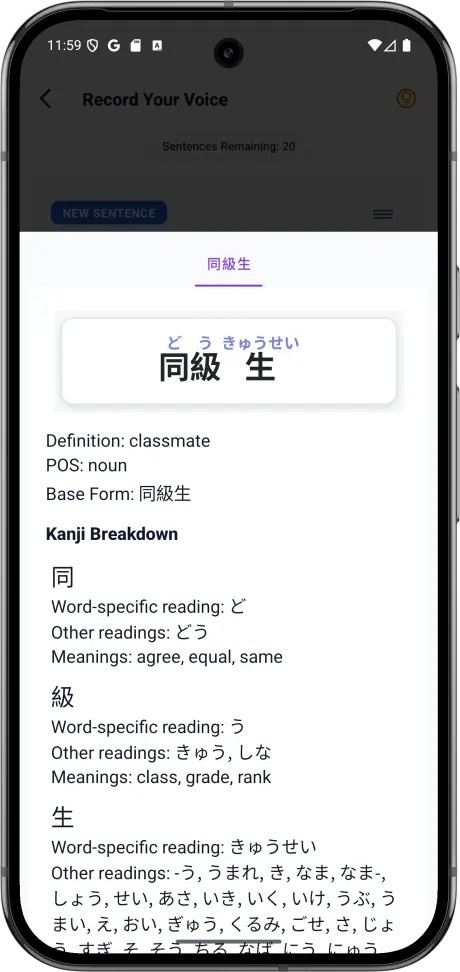
- Kanji lookup: long-press for on'yomi, kun'yomi, name readings and meanings, powered by the same parser as the free Japanese Analyzer.
- Furigana toggle and optional cloud sync with an account.
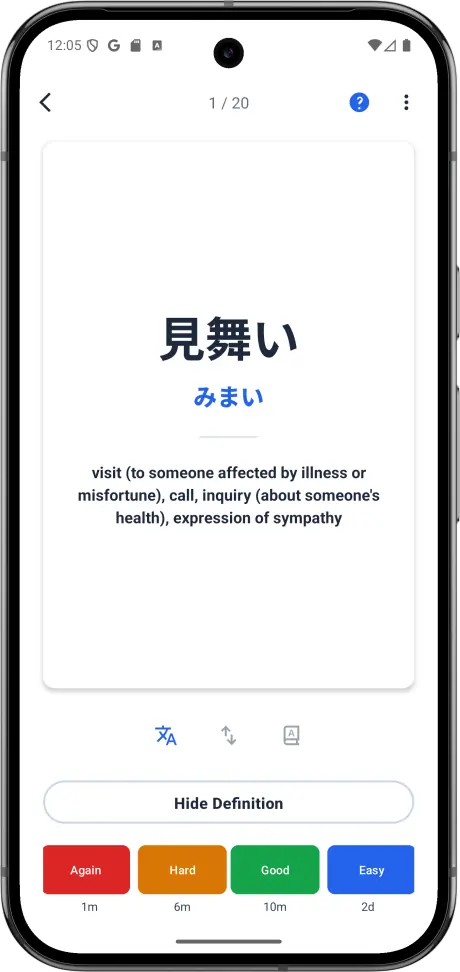
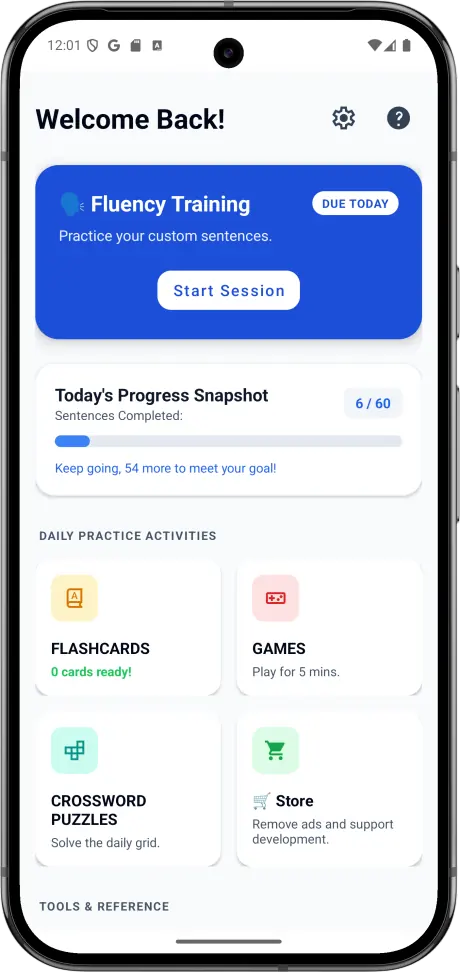
Dashboard: daily speaking goal, cards due and JLPT roadmap
The dashboard keeps the daily decision small: sentences completed against your goal, flashcards due now, and your position across the 25 sub-levels. Activity history, reminders, session settings and cloud sync stay available without competing with those three numbers.
Supporting tools use the same graded content
- Grammar Library: JLPT N5 through N1 patterns, native audio, examples and quizzes. Browse the web library.
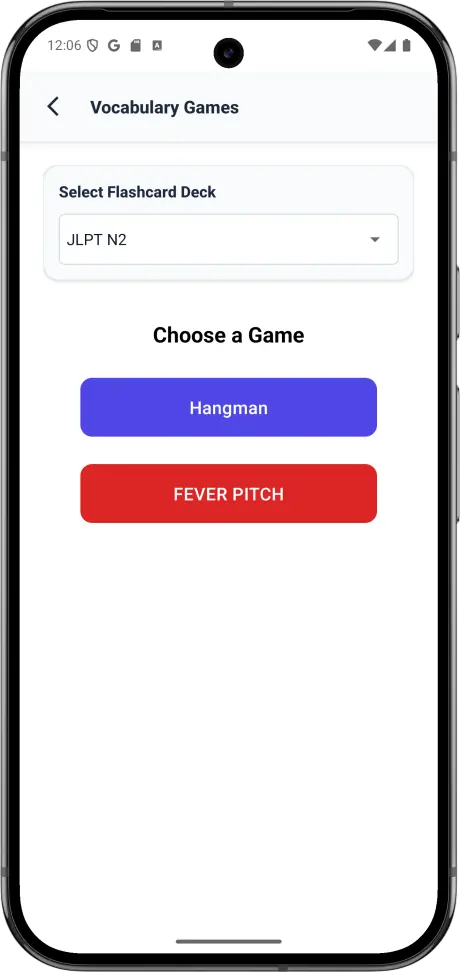
- Vocabulary games: Hangman and Speed Tap, built from the same active word lists.
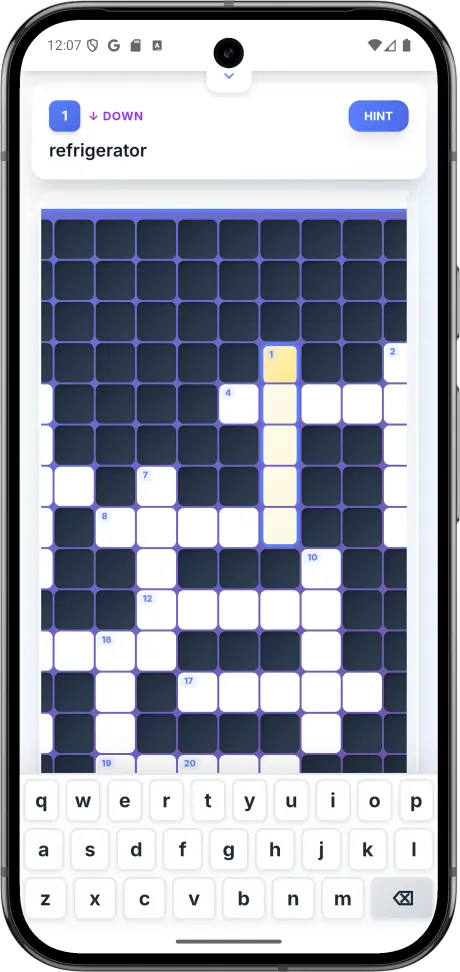
- Crosswords: Japanese vocabulary puzzles using the same JLPT-graded decks. Play the full Japanese crossword.
| Primary use | Japanese speaking practice and kanji writing |
|---|---|
| Speaking method | Echo Fluency shadowing |
| Evaluation | Speech-to-text |
| Kanji course | Kanji Tower: 103 floors, all 1,026 elementary-school kanji |
| Kanji writing | Watch, Trace and Write for all 2,136 jōyō kanji, every stroke checked |
| Dictionary | 45,064 words; kanji browsable by school grade |
| Platforms | iOS · Android · browser |
| Price | Free + one optional one-time ad removal |
| Account | Not required; optional for cloud sync |
| Levels | JLPT N5 to N1, 5 sub-levels each (25 total) |
| Prerequisite | Hiragana/katakana beyond entry survival content |
Who FluencyTool is for: three kinds of Japanese learner
You read kana but need speaking practice
Start JLPT N5 speaking practice at Sub-level 1. The lowest survival-phrase content includes romaji; beyond that, the course expects hiragana and katakana, with furigana above kanji where available.
You are studying for the JLPT
Vocabulary, grammar and sentences are filtered by level. The JLPT itself measures reading and listening, while FluencyTool adds a speaking practice loop.
You can read more Japanese than you can say
Echo Fluency is built around repeated native audio, immediate recording playback and speech-to-text evaluation. Pair it with JLPT-graded news reading for written input.
Can't read kana yet? Kana Challenge teaches hiragana and katakana first.
Pricing: free, with one optional ad-removal purchase
The core app is free to download and use. There is no trial, no card on file and no recurring subscription.
Core app
$0
Echo Fluency, flashcards, grammar guide, vocabulary games and crosswords.
Optional purchase
Ad removal
A single one-time in-app purchase removes banner ads permanently.
Watch Japanese shadowing practice in FluencyTool
A 38-second walkthrough: hear a native Japanese sentence, record your own voice, long-press a word for its dictionary definition, then review JLPT vocabulary with SM-2 flashcards.
More videos on the MySenpai YouTube channel.
What users have said
4.5 ★ from 82 ratings on Google Play.
“Great and simple app for practising Japanese speaking. Listen to each phrase and repeat it, and thanks to the text-to-speech function, the app checks that the pronunciation is correct.”
“I really enjoy this app a lot and I cannot believe it is free. TIP: Hold your finger on a kanji and it explains each one.”
“Developer got back to me with an insanely detailed response. Never seen a dev care so much about improving his app, honestly amazing!”
Frequently asked questions about FluencyTool
What is FluencyTool and how does it work?
FluencyTool is a free Japanese speaking practice app that plays a native sentence, records your repetition and scores it with speech-to-text. The Echo Fluency loop runs hands-free: the microphone opens when playback ends, your voice plays back, and the attempt is evaluated. Correct sentences are scheduled for later review and missed ones re-queue.
Is FluencyTool free?
Yes, FluencyTool is free to download and use. Echo Fluency, flashcards, the full JLPT N5 to N1 grammar guide, vocabulary games and crosswords are all included, with no trial, no card on file and no subscription. A single optional one-time in-app purchase removes banner ads.
Do I need an account to use FluencyTool?
No, FluencyTool works without an account. An account is optional and is only needed if you want cloud sync to carry your progress across devices.
Can I use FluencyTool on iPhone, Android or in a browser?
Yes, FluencyTool runs on iPhone (App Store), Android 7.0 and up (Google Play) and in a web browser. Use the app for daily practice on your phone, or open the browser version on a computer to try it without installing anything.
What JLPT levels does FluencyTool cover?
FluencyTool covers all five official JLPT levels, N5 through N1. Each level is split into 5 sub-levels, giving 25 content buckets, and the Dashboard Roadmap shows how many new sentences remain in each. A separate English-speaking track is graded by CEFR levels A1 to B2.
Can a complete beginner use FluencyTool for Japanese speaking practice?
Yes, if you can read hiragana and katakana, a beginner can start at JLPT N5 Sub-level 1. Romaji is available only for the lowest N5 survival-phrase content, so learners who cannot yet read kana should start with Kana Challenge. Furigana can be shown above kanji, and the onboarding wizard walks through the other preferences.
Does FluencyTool work offline?
Partly: FluencyTool flashcard reviews and vocabulary games work offline. Echo Fluency needs an internet connection for cloud TTS audio and speech-to-text evaluation, and crosswords, kanji lookup, the grammar guide and cloud sync also need a connection.
What do I need to use Echo Fluency?
Echo Fluency needs a device with a microphone and an internet connection. The microphone records your repetition and the connection supplies the native audio and the speech-to-text evaluation.
Does shadowing practice actually improve speaking?
Research suggests shadowing can change how fluently learners speak, though the evidence is limited. A Purdue study of 30 intermediate Japanese learners found measurable changes in pausing patterns after a semester of shadowing, but it did not find faster delivery. FluencyTool automates the shadowing loop; it does not replace speaking with a teacher or conversation partner.
How does spaced repetition work in FluencyTool?
FluencyTool flashcards use Woźniak's original SM-2 description, with Again, Hard, Good and Easy ratings adjusting each interval. Speaking sentences use a separate schedule where mastering a sentence 5 times multiplies its interval by 4.
How is FluencyTool different from Duolingo for Japanese?
FluencyTool is built around hands-free shadowing scored by speech-to-text, while Duolingo teaches Japanese mainly through gamified matching and translation with occasional speaking prompts. Every FluencyTool session is filtered to a JLPT level and sub-level you pick, whereas Duolingo's course is not organised by JLPT level. Duolingo also covers kana and writing; FluencyTool assumes kana beyond the lowest survival-phrase entry point.
What if I get stuck or have a problem with FluencyTool?
You can email the FluencyTool team at [email protected]. Include your device and the level you were practicing so the problem can be reproduced.
Does FluencyTool teach kanji?
Yes. The Kanji Tower is a 103-floor writing course that teaches all 1,026 kanji Japanese children learn in elementary school, 6 to 10 kanji per floor, in 3,924 example sentences. Each floor has a learn step, where you meet, trace and write each kanji with help, and a produce step where you write them from memory; reviews bring them back later.
Can I practise writing kanji that are not in the Kanji Tower?
Yes. Every one of the 2,136 jōyō kanji taught through junior high school has Watch, Trace and Write practice in the dictionary, with every stroke checked. The kanji page shows meanings, on and kun readings, school grade, JLPT level, stroke count, radical and example words.
Keep the same content moving between tools
- Kana ChallengeHiragana and katakana practice before FluencyTool.
- Grammar LibraryThe N5 to N1 grammar guide on the web with audio and quizzes.
- YoMooJLPT-graded news reading using related vocabulary.
- Japanese Crossword PuzzleA daily JLPT-vocabulary crossword: type romaji, get hiragana.
Say the next sentence out loud.
Free on iOS and Android, or try it in your browser. Pick a JLPT level in the onboarding wizard and start your first session.
All core features free · No subscription · Android 7.0+, iOS and web