There is a specific moment that trips up most learners and it happens right here. The kana felt like a discrete task with a clear finish line. Everything after this is a long, somewhat formless process that does not resolve into a single thing you can declare complete. That is not a warning; it is just accurate. The people who make it past the first year are the ones who figure out, early, what they are actually trying to do with the language.
This guide covers the realistic options for what comes next: vocabulary and kanji acquisition, grammar study, the textbook-versus-immersion debate, finding instruction when you need it, setting goals that mean something, and building the kind of ongoing contact with the language that produces results over time. There is no single path. There are, however, a handful of things that every successful path has in common.
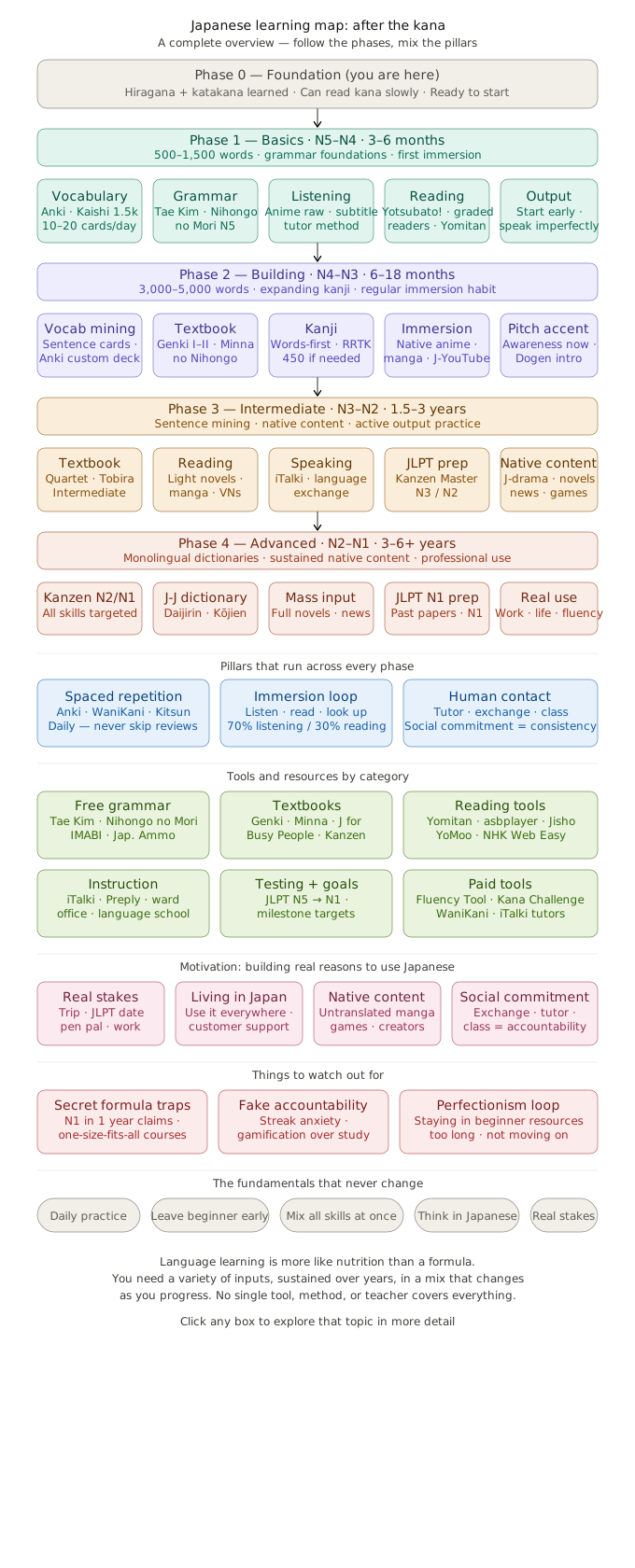
Vocabulary and Kanji: Start Together, Not Separately
Learn kanji through words from the beginning. Drilling characters in isolation, divorced from meaning and context, is how learners produce impressive stroke-order charts and still cannot read a convenience store receipt.
The temptation after finishing the kana is to tackle kanji as a distinct project. There are decks for this, books for this, entire systems built around memorizing 2,000 characters before you read a sentence. Some learners find this useful for recognizing shapes. Most find it an expensive way to delay actually using the language. The more direct path is to learn vocabulary, and let kanji come along for the ride.
Take 今日. It means "today." The characters individually mean "now" and "day," but the reading kyō is irregular; you would not guess it from the parts. You learn it as a word. Once you know fifty words with 日 in them, you start recognizing the character without drilling it. That is the process. It is slow for the first hundred words and noticeably faster after that.
Spaced Repetition: The Engine Behind Vocabulary Study
Spaced repetition is a study method built around reviewing material at increasing intervals timed to occur just before you would forget it...
Practical tip
Do Anki first thing in the morning before anything else...
When to Learn Kanji Components Separately
Best for
Learners 3+ months in who still find kanji look like noise rather than distinct shapes.
Grammar: Choose One Guide and Start Immersing Before You Finish It
Japanese grammar is fundamentally different from English grammar...
Japanese marks the relationship between words through particles...
The Textbook Option: Genki and Alternatives
Genki is the most widely used university-level Japanese textbook series...
Genki I & II
N5–N4Classroom / structured self-study
Minna no Nihongo I & II
N5–N4All-Japanese instruction; classroom or self-study with translation companion
Japanese for Busy People I–III
N5–N4Practical communication focus for adults with limited study time
Quartet I & II
N4–N3Natural continuation after Genki
Tobira: Intermediate Japanese
N4–N2Content-rich intermediate study
Kanzen Master Series
N3–N1JLPT preparation by skill: grammar, kanji, vocabulary, reading, listening
Immersion: The Part That Actually Scales
Every grammar guide, every Anki deck, every tutoring session is preparation for sustained contact with natural Japanese. Immersion is not a reward for finishing your studies. It is the method, and you can start it earlier than you think.
Language at the level of real fluency exists at a scale that no study material covers. The vocabulary you encounter in native anime, manga, novels, and YouTube videos runs into the tens of thousands of words. Textbooks cover several hundred. The patterns of natural speech, the way sentences are structured in real contexts, the words that native speakers actually reach for: none of this is accessible through study materials alone. Contact with native content is how the gap closes.
Vocabulary researcher Paul Nation's corpus work (2006) found that reading comprehension requires knowing approximately 98% of the words in a text to function without constant dictionary support. His analysis of English-language corpora put that threshold at around 8,000–9,000 word families for written text. Japanese does not map one-to-one, but the underlying principle holds: you need to know a very large proportion of words on the page before reading becomes a self-sustaining activity rather than a lookup exercise. The only path to that vocabulary mass is sustained reading. Textbooks alone will not get you there.
The objection most beginners raise at this point is that they cannot understand native content. That is accurate. Comprehension at the beginner stage will be low. The counterintuitive instruction is to start anyway, for two reasons. First, the brain picks up on patterns even when explicit comprehension is low. Second, waiting until you "feel ready" for native content is a deferral loop; readiness for native content only comes from native content.
What to Immerse With
The recommendation is always the same: content you are genuinely interested in. If you do not care about the story, you will not watch it for long. Slice-of-life anime tends to have simpler vocabulary than action or fantasy. Manga with furigana (small hiragana readings above kanji) like よつばと! (Yotsubato!) is a common starting point for reading practice. It uses informal, conversational Japanese and simple vocabulary, with enough visual context to help you guess meaning from situation. For strategies on building a reading habit that actually sticks, see the guide to immersive reading in Japanese.
The Yomitan browser extension makes reading on a computer significantly less painful. Hover over any word while holding the Shift key, and it displays the reading and definition. Combined with the asbplayer extension, you can load Japanese subtitle files onto streaming anime and look up words mid-episode. This is slow at first and becomes faster as your vocabulary grows.
Active Versus Passive Listening
Active listening means full attention: watching the screen, tracking what is said, looking up words when they repeat. This is where the real gains are. Passive listening means having Japanese audio running while doing something else: cooking, commuting, exercising. The value of passive listening is exposure volume rather than comprehension. It fills time you would otherwise spend in silence. It reinforces patterns you have already partially acquired. It is not a substitute for active study, but it costs nothing extra.
The difference between active and passive engagement is not just a matter of degree. Brain imaging research confirms that actively producing or engaging with language uses significantly more of your brain than passively hearing it. Passive listening activates the language-processing regions you would expect. Active listening and speaking pull in additional areas associated with attention, memory consolidation, and self-monitoring. More of the brain engaged means more pathways being built. Passive exposure is real input; it just does not build the same network as active use.
Most immersion-based advice is built on the idea that you learn best from input slightly above your current level. Content that is almost comprehensible stretches your understanding without losing you entirely. Content that is completely opaque gives you almost nothing to work with. This is why starting with simple, repetitive slice-of-life anime is not a concession to difficulty. It is the appropriate calibration. The goal is to move the difficulty up gradually as comprehension improves, not to stay at beginner content indefinitely and not to jump to dense literary novels in month two.
A practical ratio for the beginner stage: 70% listening, 30% reading. Listening first because it is the most natural form of the language and because getting your ear accustomed to natural speed and rhythm matters for everything that follows. The ratio can shift toward 50/50 as reading ability develops.
Practical tip
The subtitle tutor method: watch an episode with English subtitles first, then immediately watch it again without. The first watch gives you the story; the second watch lets you focus on the sounds without straining to follow the plot. It gets tedious after a few months, but it is genuinely useful in the first weeks of immersion.
Pitch Accent: The Thing Most Resources Skip
Japanese is a pitch-accent language. Each word has a pattern of high and low tones. Getting it wrong usually does not cause misunderstanding, but it does mark you as a non-native speaker. Whether that matters depends on your goals.
Most learners discover pitch accent by accident, sometime around month three or four, when a native speaker looks confused despite technically correct vocabulary. The word 橋 (bridge) and 箸 (chopsticks) are spelled identically in romaji. In spoken Japanese, they differ only in pitch pattern: bridge rises, chopsticks falls after the first mora. Context usually handles it. But there are enough of these pairs that the habit compounds over time if unaddressed.
The standard advice is to at least be aware of pitch accent from the beginning. Dogen's free introductory video on YouTube is ten minutes and covers the basic mechanics clearly. His full course goes much deeper and is aimed at learners serious about pronunciation. The Japanese pitch accent guide and the Pitch Accent Lab on this site are practical places to test and build awareness before patterns get too ingrained.
If near-native pronunciation is not a goal, skip the deep study and just stay aware that the patterns exist. If it is a goal, starting early is substantially easier than correcting habits formed over years of study.
Best for
Learners who want to sound natural in conversation, work in Japan, or interact regularly with native speakers. Pitch accent study is optional for reading and listening goals, where accuracy of pronunciation is irrelevant.
Finding Instruction: Tutors, Schools, and Language Exchange
You do not need a tutor to build a strong foundation in Japanese. The resources for self-study are genuinely excellent. Where instruction earns its cost is in speaking practice, specific feedback, and accountability for learners who need external structure to stay consistent.
The case against starting with a tutor from day one is that early instruction is expensive per unit of progress. A beginner lesson costs the same as an advanced one and covers far less ground than the equivalent time spent with Anki and a grammar guide. The cost-benefit improves dramatically once you have vocabulary and grammar foundations in place, because lessons become conversation practice rather than instruction in basics.
Where to Find Tutors
iTalki is the largest marketplace for online language tutors. It lists both professional teachers and community tutors (lower rates, less formal). For Japanese, the difference is usually whether you want structured lessons with corrections and homework, or conversation practice with a native speaker. Community tutors are fine for speaking practice once you have your footing. Professional teachers are worth the premium when you want structured feedback on grammar and output. If you are studying toward a specific JLPT level, see the JLPT grammar guides for the vocabulary and grammar targets at each level.
Preply and Verbling offer similar models. If you are in Japan, local language schools and university extension programs exist in every major city. These are considerably more expensive than online tutoring but offer classroom structure, native-speaker immersion by proximity, and sometimes JLPT preparation courses specifically.
If you live in Japan: check your ward office
Many 区役所 (ward offices) run free Japanese language classes for residents. These are usually taught by volunteers, often retired Japanese seniors who want to help newcomers adjust to life in Japan. The quality varies, but the format is small-group conversation practice rather than formal instruction, which means you will speak far more than you would in a paid class. The sessions also put you in the room with people who actually live in your neighborhood. Check your ward's official website or stop by the community information desk and ask about 日本語教室 (Japanese language classes).
Language Exchange
A language exchange is an arrangement with a Japanese native speaker who is learning English. You spend half the session speaking Japanese, half speaking English. It is free, and the idea is appealing. In practice it is harder to maintain than it sounds. Exchanges tend to drift toward whichever language both people are more comfortable in, which is usually English. Progress in Japanese stalls, the sessions feel less useful, and they quietly stop. Even when both parties are disciplined, conversation can get stuck at a low-intermediate level, cycling through the same topics and vocabulary without pushing either person further.
The exchanges that stay useful over time tend to have structure: each person brings a short text in the target language, a news article, a textbook passage, or a scene from something they have been reading. Working through the material gives the session a purpose beyond small talk, introduces new vocabulary, and gives the other person something to explain rather than just respond to. HelloTalk is a reasonable platform for finding exchange partners, though expect to try several before finding someone whose schedule and level align consistently with yours.
Discord servers for Japanese learners can be useful, but probably not in the way they are often pitched. Most do not function well as learning tools. They work as communities: places to ask specific questions, share frustrations, find content recommendations, and occasionally run into someone who knows the answer to the weird grammar pattern that has been confusing you for a week. Genuine Japanese-themed discussion channels can offer real exposure to the language in context, which is more valuable than meta-discussion about studying. Whether a specific server is useful tends to come down to its active members and current culture, which changes over time. WaniKani maintains a comprehensive list of Discord servers for Japanese learners that is worth browsing if you want to find one that matches your interests and level.
On output timing
Some immersion-method guides advise delaying speaking practice until your Japanese is "solid." In practice, this tends to produce learners who have good passive comprehension and real anxiety about speaking. Speaking imperfectly is fine. You will produce broken sentences, and you will hear yourself do it, and you will adjust. This is faster than waiting.
Why Human-to-Human Contact Is a Learning Tool, Not a Reward for Progress
Instructor-led lessons, language exchanges, study groups, tutors, and ward-office conversation classes have something in common that no app can replicate: another person is expecting you to show up. That sounds like a minor thing. In practice, across a multi-year learning timeline, it is one of the most reliable mechanisms for staying consistent.
Social psychology research consistently finds that people experience a meaningful negative emotional response when they fail to honor commitments made to other people. This effect, sometimes called social accountability, is stronger than internal commitments made to oneself. You can skip your Anki session without consequence. Standing up a tutor, missing a conversation class, or canceling on a language exchange partner is uncomfortable in a way that is hard to rationalize away. That discomfort, applied consistently, becomes a reliable push to show up even when motivation is low.
This matters most in the middle stages of learning Japanese, when the initial novelty has worn off but functional fluency is still years away. The early months have their own energy. Advanced learners are pulled forward by genuine ability to consume content they enjoy. The middle stretch, somewhere between N4 and N2, is where many learners quietly stop. A standing appointment with another human is harder to abandon than a solo study habit during this period, and the social relationship that builds around that appointment can become its own motivation to continue.
Study groups, even informal ones, carry a similar dynamic. Knowing that three other learners are going to discuss what they covered this week creates mild but real accountability. Online communities can generate some version of this, though with less force than in-person relationships. If you live in Japan, the people at your ward-office Japanese class, your conversation exchange partner, or your iTalki tutor represent recurring human relationships that the language is embedded in. That embedding is a motivator that no amount of well-designed gamification fully substitutes for.
The same mechanism can be manipulated
The discomfort of breaking a social commitment is a genuine psychological force, and app designers know it. Streak systems and heavily gamified learning platforms simulate the emotional cost of letting someone down by attaching anxiety and loss aversion to a counter on your phone screen. "Don't break your streak" works because it borrows the emotional weight of social accountability and applies it to an entirely private behavior. The result is users who log in to protect a number rather than to actually learn, and who feel genuine distress when the streak breaks, as if they let a person down. Recognizing this pattern does not make it stop working. It just helps you decide whether the anxiety is producing actual learning or just app engagement.
Setting Goals: The JLPT and What It Actually Measures
The Japanese Language Proficiency Test provides structured milestones and an internationally recognized credential. It measures reading and listening comprehension only. There is no speaking or writing component, which means passing N1 and being able to hold a conversation are different things.
The JLPT has five levels, N5 through N1. N5 is the entry point: basic vocabulary, hiragana and katakana, simple sentences. N1 is the top: around 10,000 vocabulary items, complex reading passages, fast and varied listening. The test is offered twice a year in Japan (July and December) and once a year in many other countries.
Basic vocab, kana reading, simple sentences
~1500 words, basic kanji, conversational grammar
~3750 words, reading short texts, intermediate grammar
~6000 words, reading newspapers, workplace Japanese
~10,000 words, complex texts, nuanced listening
The JLPT is useful as a forcing function. Committing to N5 in six months gives your vocabulary study direction. Committing to N3 in eighteen months gives you a grammar list to work through deliberately. The test structure incentivizes covering material you might otherwise skip in favor of content you enjoy.
Its limits are real. N1 certification is required by some Japanese employers in white-collar fields, and immigration applicants can earn extra points toward a skilled professional visa with it. For most learners, though, it is a benchmark rather than a destination. Someone who passed N1 by studying JLPT-specific materials and has not done much listening or speaking practice may perform worse in an actual conversation than someone who never took the test but has spent 500 hours watching raw anime.
Setting Goals That Survive Contact with Reality
The most durable goals are attached to things you actually want to do, not things you abstractly want to have achieved. "Read manga in Japanese without a dictionary" is a more sustainable driver than "reach N2" because the manga exists and you can open it every day. "Understand this one anime raw" is more sustainable than "understand all anime raw" because the finish line is visible.
Milestone-based goals are also useful for momentum. The guides in the immersion community use metrics like "10 raw anime series" (the point at which listening starts to feel natural), "1 novel finished" (the point at which reading ability has genuinely developed), and "5 novels" (the point at which you can no longer honestly call yourself a beginner reader). These are rough and personal, but they are more grounded than JLPT levels for learners who are not actually taking the test.
Ignore Anyone Selling a Secret Formula
Especially anyone charging for it. The story of "how I reached N1 in one year" is a distraction whether it is true or not, and it is usually not true. Japanese is a long-term personal commitment, not a system anyone else can hand you.
At some point you will encounter a course, a YouTube channel, or a paid program built around someone's claim that they reached N1 in twelve months using their particular method. The pitch is always variations of: extreme immersion hours, a specific deck, a specific grammar guide, and a specific daily schedule. Sometimes the claim is genuine and the person did make exceptional progress. More often the timeline is retrospectively compressed, the starting level was higher than implied, or N1 was passed on a good day without speaking ability to match.
None of that is really the point. Even if someone genuinely did it, their path is not your path. Language learning is personal in a way that almost no other skill is. What clicks for one learner genuinely does not click for another. The grammar explanation that finally made particles make sense for you might be completely wrong for someone else. The anime series that made listening feel natural to one person is too dense, too fast, or too boring for the next. Anyone offering a one-size-fits-all system for acquiring Japanese is either mistaken about how language learning works or not being fully honest about what they are selling.
A more useful mental model for Japanese acquisition is nutrition. There is no single food that gives you everything. You need a variety of inputs over time: vocabulary from flashcards, grammar from structured study, listening from native content, reading from manga and novels, speaking from output practice, and enough time for all of it to consolidate. The specific balance changes as you progress. What your Japanese needs at month two is different from what it needs at year three. A diet of only immersion produces learners who understand a lot and cannot produce sentences under pressure. A diet of only textbooks produces learners who can pass tests and stumble at the ticket machine. The goal is variety and time, not the optimal algorithm.
This also means your relationship with specific tools will change. The Anki deck that served you well for the first 1,500 words may feel mechanical and unrewarding at 5,000. The grammar guide that gave you exactly what you needed at N5 may have nothing useful left to offer at N3. The anime series that made listening feel accessible at six months may feel too easy to maintain attention at eighteen. This is normal. Tools have shelf lives in language learning. Using something past the point where it is serving you, out of loyalty or sunk cost, is a common way to stall.
A quick filter for any Japanese learning product
Does it claim a specific, dramatic outcome in a specific, short timeframe? Does it imply that other methods are wrong and this one is the correct one? Is there a paid component gatekeeping the "real" content? These are not automatic disqualifiers, but they are reasons to look more carefully at what is actually being offered versus what is being implied.
The Things That Stay True Regardless of Path
Every successful Japanese learner, regardless of method, shares a few habits. These are not opinions about which approach is better. They show up consistently across people who actually reach functional ability.
They do something every day.
Not necessarily for long. Not necessarily in the same format. Ten minutes of Anki reviews on a bad day maintains retention more than a three-hour session after a two-week break. Consistency compounds; interruptions cost more than they appear to.
They leave beginner materials before they feel ready.
Perfectionism is expensive in language learning. Finishing Genki and immediately starting the next textbook is a way to feel safe. Moving to real content before you feel ready is how you actually develop the ability to handle real content. The discomfort of not understanding everything is not a sign that you need more preparation. It is the preparation.
They learn vocabulary, grammar, and real content at the same time.
The wrong sequence is: learn all the kana, then all the vocabulary, then all the grammar, then finally try immersion. The right sequence is: do some of all of them simultaneously, from the beginning. Grammar without vocabulary has nothing to attach to. Vocabulary without grammar has no structure. Both without exposure to natural language produce learners who can pass tests and flounder in conversation.
They stop translating everything.
Processing Japanese by internally translating every sentence to English is slow, error-prone, and does not produce fluency. The goal is to encounter Japanese and arrive at meaning directly, the same way a proficient reader processes their first language. This takes time and it cannot be forced; it develops through accumulated exposure. But consciously working against the translation habit, starting earlier, speeds it up.
They have a real reason to use the language.
More on this below, but it bears stating plainly here: the learners who reach functional ability in Japanese almost universally have a concrete reason the language matters to their life. Not "it would be cool to know Japanese." Something specific.
Creating Real Reasons to Use Japanese
Motivation based on the abstract idea of fluency tends to hold for about three months. The learners who keep going past that point have usually found a concrete use for the language that generates its own reasons to continue.
This sounds obvious, but it has real implications for how you structure your study. If your goal is to enjoy a specific manga series that has not been translated, you will find yourself reading Japanese because you want to know what happens next, not because you scheduled study time. If you have a Japanese pen pal whose English is limited, you will write in Japanese because the alternative is not communicating. These external stakes are more reliable than discipline over a multi-year timeline.
Ways to Create Real Stakes
Book a trip to Japan
Six months of study with a concrete date on the calendar changes the daily practice calculus entirely. Reading a menu, asking where the toilet is, figuring out the train system without English-mode apps: these are goals that feel immediate rather than hypothetical. Even a one-week trip creates months of motivated study before it.
Join a language exchange
A consistent exchange partner is a standing appointment. Missing your study session is abstract; standing someone up is concrete. Partners who become actual friends through these exchanges tend to keep studying long after the formal exchange structure falls away, because the relationship itself requires the language.
Add it to your work context
If your industry has Japanese clients, suppliers, or colleagues, make the connection explicit. Offer to handle correspondence. Sit in on a meeting you would otherwise miss. Japanese ability that has a visible application at work generates review feedback in a way that solitary flashcard study cannot.
Find untranslated content you genuinely want
A game that was never localized. A manga series you have been waiting to finish. A YouTube creator who makes content in Japanese you want to follow. These are not study materials. That is exactly the point. When the content itself is intrinsically interesting, the language becomes the medium rather than the subject.
Engage with Japanese in Tokyo
If you are already in Japan, the city itself is your resource. Read menus. Navigate the train system in Japanese. Order food by pointing at kanji and pronouncing it imperfectly. Every successful transaction in Japanese is feedback that the study is working, which is a motivational signal that no flashcard app can replicate.
Register for a JLPT exam
Signing up and paying the registration fee makes the goal non-hypothetical. The test has a date. The vocabulary list is finite and public. The grammar points at each level are documented. Having an exam booked shifts daily practice from optional to scheduled in a way that abstract goals tend not to.
Call or chat Japanese customer support (sorta-kinda but not really joking)
This is not a drill. Japanese companies have customer support. They speak Japanese. Chat and text-based support is an underrated option for written output practice: you have to describe your issue clearly, read their responses, and respond in kind, in Japanese, under mild time pressure. There is no pre-written script. For learners already living in Japan, calling customer support is the real thing. Your phone plan, your internet provider, your appliance warranty. Nobody on the other end will slow down because you are studying. That combination of low stakes (nobody is watching) and high stakes (you actually need to resolve the issue) is genuinely hard to replicate in a lesson.
Living in Japan gives you a standing advantage that is easy to underuse. The language is on every sign, every announcement, every menu, every customer service interaction. Passive exposure is higher than anywhere else. But passive exposure alone does not produce fluency; active use does. Japan offers the opportunities; you still have to choose to speak rather than defaulting to English whenever a staff member or neighbor offers that option.
The Best Tools Are Probably Not the Ones You Saw Advertised
Heavy marketing budgets and language learning apps are not mutually exclusive, but they are not the same thing as quality. The resources that have produced the most genuine results among advanced learners are almost universally ones that spread by word of mouth.
Duolingo's advertising budget runs into the hundreds of millions of dollars annually. Its owl is one of the most recognized brand characters in app stores. Its Japanese course covers roughly N5–N4 vocabulary with heavy scaffolding and no speaking component. Meanwhile, Anki has no marketing budget, an interface designed sometime around 2008, and is used by medical students memorizing pharmacology, lawyers memorizing case law, and a substantial percentage of people who have actually reached functional Japanese. That contrast is not a coincidence.
The tools that spread by reputation in the Japanese learning community tend to do so because they solve a real problem well, not because they have a polished onboarding experience. Yomitan is a browser extension that makes reading Japanese on a screen manageable. It has no social media presence. Anki looks like it was designed by someone who prioritized function over everything else because it was. The immersion guides that circulate most widely in learner communities were written by individuals on their own websites, not product teams with A/B tested copy. This is not nostalgia for lo-fi tools. It is a pattern worth noticing when you are deciding where to spend your time.
When evaluating a new resource, two questions are more useful than the promotional copy: who is recommending this, and what level did they reach? A recommendation from someone who got to conversational Japanese in two years means something. A recommendation from the app's own marketing page means considerably less. The learner communities on Reddit's r/LearnJapanese, the TheMoeWay Discord, and language forums like JALUP have spent years filtering what actually works, often with brutal honesty. Those consensus picks are a better signal than any app store ranking.
A useful filter
If a Japanese learning product spends more effort on gamification, streaks, and push notifications than on the quality of the Japanese it teaches, that is diagnostic. The goal is Japanese. Everything else is a retention mechanic.
Paying for Apps and Tools: What You Actually Get
It is entirely possible to learn Japanese using only free resources. The question is not whether you can; it is whether you will. Paying for a service does something to your behavior that free access rarely replicates: it makes you show up.
The core free toolkit for Japanese is strong. Anki is free. Tae Kim's grammar guide is free. Nihongo no Mori's YouTube channel is free. Yomitan is free. Jisho.org is free. Tadoku graded readers have free tiers. An enormous amount of anime, manga, and Japanese YouTube content is accessible without a subscription. A learner who works through all of these consistently and seriously will make real progress.
Textbooks are the one area where spending money becomes practically unavoidable for most learners. Genki, Quartet, Minna no Nihongo, and the Kanzen Master series are not available in useful free versions, and the structure they provide is not easily replicated by cobbling together online resources. At some point, buying a textbook or two is a reasonable investment. It is not strictly required, but most learners who get past N4 have owned at least one.
Beyond textbooks, the case for paid app subscriptions is less about features and more about psychology. Paid users of any service are consistently more engaged than free users, across virtually every category of product. This is not a quirk of Japanese learning; it is a documented pattern in subscription economics. The commitment of payment changes how people relate to the tool. They open it more. They use it for longer. They return to it after gaps instead of abandoning it.
This pattern shows up clearly in our own data. Paid users of Fluency Tool and Kana Challenge are remarkably consistent with their study schedules. Their daily average study times regularly exceed one hour per day, sustained across weeks and months, not just the first enthusiastic week after signup. Free users study in bursts. Paid users study regularly. Over a multi-year learning timeline, that consistency is the single largest variable in how much Japanese someone actually acquires.
The implication is not that paying for something makes it good, or that you should pay for everything. It is that paying for a specific tool you intend to use daily functions as a commitment device. You are not buying features. You are buying yourself into a behavioral pattern that makes language acquisition more likely. If the free version of something is already working and you are already using it every day without any external pressure, the paid version probably will not change much. If you keep starting and stopping, the friction of payment might be exactly what anchors the habit.
Strong free options
- Anki: spaced repetition, full functionality free
- Tae Kim's Guide: complete grammar foundation, free PDF
- Nihongo no Mori: structured JLPT video lessons, free on YouTube
- Yomitan: dictionary browser extension, free
- Jisho.org: dictionary and example sentences, free
- NHK Web Easy: simplified Japanese news, free
Where paying tends to help
- Textbooks: Genki, Kanzen, Minna no Nihongo (structure hard to replicate free)
- Speaking practice tools: feedback requires infrastructure
- Apps you will use daily: payment as a commitment device, not a feature upgrade
- iTalki tutors: for output feedback once vocabulary is in place
- JLPT practice tests: official past papers are worth purchasing for exam prep
The honest version of the cost question
The most expensive Japanese study routine is the one you abandon. The cheapest is the one you actually do every day. Cost and consistency interact. A paid tool you use daily for two years will produce more Japanese ability than a free tool you use sporadically for five. Before asking whether a paid version is worth the money, ask whether the free version has already made you a consistent daily user. If yes, stay free. If not, the payment might be the missing piece.
A Realistic Daily Loop
Structured advice about daily study routines tends to fall apart within two weeks. The goal is not the schedule; it is the minimum viable version of the schedule that survives actual life.
The full version of a daily Japanese study routine, at the beginner stage, looks like this: 20 minutes of Anki, 30 minutes of grammar study, and 60–90 minutes of immersion (split between reading and listening). That is two hours total. Two hours is realistic for someone with genuine free time and no competing demands. It is not realistic every day.
The minimum viable version: do your Anki reviews. That is it. Reviews are capped, finite, and completable in 15 minutes on a normal day. If you do only one thing on a day when everything else fell apart, make it reviews. Skipping new cards is fine. Skipping reviews means they accumulate, and a pile of 300 accumulated reviews is what causes people to abandon the deck entirely.
Suggested daily structure (beginner)
On bad days: Anki reviews only. On good days: everything. Adjust new card count if reviews are piling up.
Frequently Asked Questions
What should I study after learning hiragana and katakana?
Start vocabulary and grammar simultaneously. A beginner Anki deck like Kaishi 1.5k covers the most common 1,500 words. For grammar, a free guide like Tae Kim handles the foundations (the PDF is available at guidetojapanese.org). Add immersion from day one, even if you understand almost nothing. The sequencing trap: finish vocabulary, then do grammar, then start immersion. It produces people who have studied for a year and still cannot read a sentence of natural Japanese.
Should I use Genki or a free online guide?
Genki builds a solid, complete foundation and is the standard classroom resource. It works best with a study partner or in a class. Free guides like Tae Kim or Yokubi cover similar ground and are better for solo self-study. Both paths produce the same N5–N4 base. Pick the one you will actually open every day; the format you stick with is the better one.
When should I start studying kanji?
From the beginning, indirectly. Learn kanji as part of words rather than in isolation. When you learn 今日 (today), you are learning kanji. When you learn 水 (water), you are learning kanji. Drilling characters alone, before you have vocabulary, is a way to feel productive without making much actual progress.
Is the JLPT worth studying for?
As an external benchmark with a structured vocabulary and grammar list, yes. It gives your study direction and produces a credential that some employers and visa programs recognize. As a measure of full fluency, it is incomplete: the test has no speaking or writing component. Passing N1 and being able to hold a conversation are related but genuinely different things.
How do I stay motivated long-term?
Build real reasons to use the language. A pen pal, a trip with a date, an untranslated manga you actually want to finish, a work context where Japanese ability is visible and useful. Motivation built only on the abstract idea of fluency tends to fade around month three. Concrete use cases generate their own momentum in a way that willpower alone does not.
Do I need a tutor?
Not to build a solid foundation. The self-study resources for Japanese are genuinely good. A tutor becomes most useful for speaking practice and real-time feedback once you have enough vocabulary and grammar to form sentences. Starting with a tutor from day one is expensive and slow relative to what the same time and money would cover in structured self-study.
What is immersion and why does every guide keep mentioning it?
Immersion means consuming content made for native speakers rather than for learners: raw anime without subtitles, manga, novels, YouTube in Japanese. It matters because language exists at a scale that no structured resource covers. The vocabulary range of natural Japanese content is in the tens of thousands of words. Textbooks cover several hundred. The gap between those numbers is closed only through sustained contact with natural content.